Snake Man Primes are the warrior and dominant caste of snake men. They only have male snake sexual organs. There are 7919 lines of Primes, a number that has not changed since the original mutation in a batch of temple servitor eggs on Celestia birthed the species.
Each line has a Prime, the eldest living member of the genetic line. When the previous Prime is killed (a Prime is effectively immortal and will not die of natural causes) the next oldest member of the line becomes the new Prime. Only the Prime of each line can reproduce; upon achieving Primehood the four organ tentacles constantly emit spores that grow into a fleshy mycelial mat in the presence of energy and moisture. These mycelial mats produce fruiting bodies with a water filled pod on top. Connections through shadow to Shadow DNA (sDNA) cause mycelial tissue in a specialized node to turn into animal flesh and a tadpole is formed which swims up the stalk of the fruiting body and lives in the pod, eating algae blooms in the water if there is light present or pieces of the fruiting body itself which decay and fall off in the absence of light. A fully grown tadpole bursts from its pod and wriggles to a dark place to metamorphosize into the adult snake man form. Each snake man is an exact genetic clone of the Prime of its line with whom he shares a telepathic link of unlimited range.
When a snake man becomes Prime a set of genes are activated which cause a dwarf female conjoined twin to grow along the arm and left shoulder. One eye opens in the palm of the left hand from which the female twin can see. It takes many years for the newly developing female twin to achieve adulthood, and many more years to fully access the memory of the previous female twins. A fully mature female twin has full access to the memories of all her clone-sisters before her. Even newly forming female twins have powerful psychic abilities which add to the battle prowess of the Prime. When a Prime raises its left hand in battle and the eye of the twin opens, enemies cower and flee. Over long centuries the female twin's continued growth causes a hunchbacked deformity that saps the physical strength of the Prime even as the psychic powers of the twin continue to expand exponentially. The lines of the Primes are ranked according to the longevity of the Prime of the line. The oldest Primes are completely dominated by their female twins in normal life, existing in a kind of vegetable slumber while the twins hone their mental skills. The 10 oldest primes have not stirred for over 20,000 years. If roused the combination of deformed male Prime warrior and ancient female psionist would be perhaps one of the deadliest combatants in the multiverse.
Wednesday, March 6, 2013
Snake Man Biology Pt. 1 - Introduction
I introduced the Snake Men in my 4e campaign in Session Numero Uno through the wild tales of a swamp trapper who told of a "city made of gold" that he and his friends had discovered, which he claimed was inhabited by snake men.
A handful of sessions later the party was in an alien spacecraft made of pure energy and they were accessing the data logs of several linked satellites in stable planetary orbit. In the course of observing several billion years of planetary formation they also caught a relative blink-of-the-eye in time highlighted by a meteorite slamming into the exact center of the formation of alien spacecraft, forming the depression now filled by the swamp. Yes, the many minareted and domed city which stood on the meteorite was made of gold. A circular rocky ridge in the center of the swamp, thrown up by the impact, conceals the city of gold. Mushroom life sprouted across the meteorite shortly after the crash, and from the mushrooms sprang tadpoles which metamorphosized into snake men. To the party's horror they discovered that all of the humanoid races of the planet had their origin as experiments released by the snake men scientists into the swamp.
When the party thought to look for the visual evidence of the swamp trampers finding the city, they observed two snake men meet the three trappers on the top of this ring. A snake man held up its hand and two of the trappers disintegrated into dust. The third trapper soiled himself as the other snake man grasped him solidly for a moment before releasing him. The party's informant fled promptly.
Curious, the party kept investigating that moment in time through satellite footage and discovered that the outbreak of the white death plague could be reliably dated to shortly after the return of this swamp trapper to the settlement.
Several sessions later, the party had crossed the mountains and was exploring the verdant rainforest beyond. They found an artifact of the snake man, a flying laser shield meant to be worn by a snake man warrior. This shield revealed that the snake men had four small organs that could interact with four circular depressions on the inside of the shield, like four sensitive finger-tentacles that stick out of the snake man torso.
Using ritual magic to look into the shield's past, they watched its creation by snake man scientists, all of whom had four arms. The scientists tended to mats of mycelial tissue which they grew in molds in the shape of the shield and many other items (I just realized that the use of the word "mold" in the sense of a 3-dimensional negative shape that you pour or push a substance into to form a sculpture could be confusing when the substance that fills the mold is mycelium!). When the molds were full of mature mycelium the snake man scientists activated a complex arrangement of pearls and gemstones that transferred energy through shadow and turned the mycelium into many different substances, gold in the case of the enchanted flying shield. The discovery of this shield was the first step in the party's current understanding of how to manipulate energy through shadow, the foundation of a true understanding of magic.
When the party began to piece together the history of the city states of the great human civilization on the other side of the mountains they realized that the influence of the snake men had crossed that great natural barrier long ago. They discovered the fingerprints of the snake men in the blood tattoo magic that raised their hackles.
Even Manu Jablitu, the ancient technomancer lich who has become number one on the party's most wanted list for quite a few sessions in a row now, was first encountered because his services were procured by the snake men to solve a dimensional instability. A while back the players in my Mutant Future campaign discovered an alien installation in a strange dimension that had a machine in it containing the entire 4e probaverse in a controlled singularity. A player running PCs in both campaigns looked at the machine and infamously said "I'll flip some switches". I asked him to roll d100 and he rolled a critical failure "01". As a result, the machine began powering down and the stars started going out in my 4e campaign and many monumental constructions of the ancients that drew their power from the stars no longer worked. The snake men were pissed and Manu Jablitu was brought in to fix things, but interestingly the 4e party managed to stabilize the probaverse without resorting to reprogramming the machine like Manu Jablitu intended to do. All Manu Jablitu has done since is rise to near mythological status as the party keeps encountering more evidence of the crap he has done in the past. Much of which was done under the patronage of the snake men, evidently.
I bring all this up because last session Beautiful Bob used the psychic enhancing module in the radiant energy vortex that he was accessing from the energy bath of the lich Pay-Gon to split his consciousness into 16,000 pieces to simultaneously accept a telepathic information feed from the 16,000 intellect-equivalent crystal gas mind the party encountered. It may take him a while to process, but Beautiful Bob actually received the entire genome of both the warrior or "snake man prime" caste and the four-armed scientist caste in this telepathic transmission from the crystal gas mind.
I plan to write several posts about the biology of the snake man now that the party would definitely know the ins and outs.
A handful of sessions later the party was in an alien spacecraft made of pure energy and they were accessing the data logs of several linked satellites in stable planetary orbit. In the course of observing several billion years of planetary formation they also caught a relative blink-of-the-eye in time highlighted by a meteorite slamming into the exact center of the formation of alien spacecraft, forming the depression now filled by the swamp. Yes, the many minareted and domed city which stood on the meteorite was made of gold. A circular rocky ridge in the center of the swamp, thrown up by the impact, conceals the city of gold. Mushroom life sprouted across the meteorite shortly after the crash, and from the mushrooms sprang tadpoles which metamorphosized into snake men. To the party's horror they discovered that all of the humanoid races of the planet had their origin as experiments released by the snake men scientists into the swamp.
When the party thought to look for the visual evidence of the swamp trampers finding the city, they observed two snake men meet the three trappers on the top of this ring. A snake man held up its hand and two of the trappers disintegrated into dust. The third trapper soiled himself as the other snake man grasped him solidly for a moment before releasing him. The party's informant fled promptly.
Curious, the party kept investigating that moment in time through satellite footage and discovered that the outbreak of the white death plague could be reliably dated to shortly after the return of this swamp trapper to the settlement.
Several sessions later, the party had crossed the mountains and was exploring the verdant rainforest beyond. They found an artifact of the snake man, a flying laser shield meant to be worn by a snake man warrior. This shield revealed that the snake men had four small organs that could interact with four circular depressions on the inside of the shield, like four sensitive finger-tentacles that stick out of the snake man torso.
Using ritual magic to look into the shield's past, they watched its creation by snake man scientists, all of whom had four arms. The scientists tended to mats of mycelial tissue which they grew in molds in the shape of the shield and many other items (I just realized that the use of the word "mold" in the sense of a 3-dimensional negative shape that you pour or push a substance into to form a sculpture could be confusing when the substance that fills the mold is mycelium!). When the molds were full of mature mycelium the snake man scientists activated a complex arrangement of pearls and gemstones that transferred energy through shadow and turned the mycelium into many different substances, gold in the case of the enchanted flying shield. The discovery of this shield was the first step in the party's current understanding of how to manipulate energy through shadow, the foundation of a true understanding of magic.
When the party began to piece together the history of the city states of the great human civilization on the other side of the mountains they realized that the influence of the snake men had crossed that great natural barrier long ago. They discovered the fingerprints of the snake men in the blood tattoo magic that raised their hackles.
Even Manu Jablitu, the ancient technomancer lich who has become number one on the party's most wanted list for quite a few sessions in a row now, was first encountered because his services were procured by the snake men to solve a dimensional instability. A while back the players in my Mutant Future campaign discovered an alien installation in a strange dimension that had a machine in it containing the entire 4e probaverse in a controlled singularity. A player running PCs in both campaigns looked at the machine and infamously said "I'll flip some switches". I asked him to roll d100 and he rolled a critical failure "01". As a result, the machine began powering down and the stars started going out in my 4e campaign and many monumental constructions of the ancients that drew their power from the stars no longer worked. The snake men were pissed and Manu Jablitu was brought in to fix things, but interestingly the 4e party managed to stabilize the probaverse without resorting to reprogramming the machine like Manu Jablitu intended to do. All Manu Jablitu has done since is rise to near mythological status as the party keeps encountering more evidence of the crap he has done in the past. Much of which was done under the patronage of the snake men, evidently.
I bring all this up because last session Beautiful Bob used the psychic enhancing module in the radiant energy vortex that he was accessing from the energy bath of the lich Pay-Gon to split his consciousness into 16,000 pieces to simultaneously accept a telepathic information feed from the 16,000 intellect-equivalent crystal gas mind the party encountered. It may take him a while to process, but Beautiful Bob actually received the entire genome of both the warrior or "snake man prime" caste and the four-armed scientist caste in this telepathic transmission from the crystal gas mind.
I plan to write several posts about the biology of the snake man now that the party would definitely know the ins and outs.
Saturday, February 9, 2013
Pai-Gon's Hexagonal Experiments
Poking around in the arch-lich Pai-Gon's work room whilst trying not to draw the ire of the incredibly powerful crystal intelligence bound into the tree of human arms flesh golem thing, some members of my 4e group decided to open up some random sealed ceramic containers.
These containers were roughly cubic, with each face of the cube being a hexagon and some odd faceted angular faces making up the difference. Each container was stacked six high with the sealed opening facing out into the room, in three rows six containers long.
Each container held one of Pai-Gon's experiments, left to bathe in the mutating and energizing radiation emitted by the Huwawa Complex after Pai-Gon mysteriously disappeared.
I made some random tables to determine the contents of each jar. They proved to be very stimulating in play, causing quite a few "what the fuck" moments amongst the players as they had no clue what they were getting themselves in to.
Roll on each chart. 4e Plant, Animal or Insect refers to an organism native to the "prime material plane" or whatever you want to call the normal plane of existence that D&D is played in. Planet X refers to an inhabited planet in another dimension/plane of existence that has a considerably different periodic table and physics.
Chart 1: Physical Environment inside the container (d20)
1-3: Fresh Water
4-5: Salt Water
6: Acidic Liquid
7: Basic Liquid
8-9: Acidic Soil
10: Ph Neutral Soil
11: Basic Soil
12: Silt/Inorganic Mud
13-14: Organic Mud
15-16: Clay
17: Solid Rock
18: Crystal
19: Metal
20: Metallic Gas (some heavy metals in Dimension X have a gaseous state)
Chart 2: Subject of the Experiment (d20 - containers with plants have a magical light source and magically regulated growing conditions, containers with animal and insect experiments also contain appropriate food species - many containers are much larger inside than their external dimensions would suggest)
1-4: 4e Plant (roll d10: 1-2: Fungus, 3-4: Flowering Plant, 5-6: Succulent Plant, 7-8: Bush, 9-10: Tree)
5-7: 4e Plant / Planet X "plant" hybrid
8-10: Planet X "plant" (roll 2d6: first d6: 1-3: Carniverous, 4-6: Chemosynthetic, second d6: 1-2: Mobile, 3- 4: Anchored but moving parts, 5-6: Stationary)
11-12: 4e Amphibian (roll d6: 1-2: Frog, 3-4: Toad, 5-6: Salamander)
13-15: 4e Insect (roll d6: 1-2: Crawling, 3: Jumping, 4: Digging, 5-6: Flying)
16-18: 4e Insect / Planet X "insect" hybrid
19-20: Planet X "insect" (roll d6: 1: Crawling, 2: Jumping, 3: Digging, 4-5: Flying, 6: Teleporting)
Chart 3: Broad area of Pai-Gon's interest that the experiment falls into (d20) (combine with subject matter and environment to determine purpose and exact contents of each experimental container)
1-2: Protection from Damage
3-4: Controlling Agression
5-6: Controlling Emotion
7-8: Protection from Fire
9-11: Love
12-13: Dispelling Magic
14-17: Plant Propagation
18-20: Insect Breeding
21-30: Shadow Plant Analogs (I put this entry in the chart because we use the d30 houserule - once a session replace any roll with a d30 roll. What exactly a shadow plant analog is might be a subject for an entire post on its own I think)
Chart 4: Current State of the Experiment (d6)
1-3: Experiment existing in stasis and performing as designed by Pai-Gon
4: Stasis failed due to Huwawa field, contents destroyed
5: The experiment succeeded but the intended results have run wild for thousands of years
6: The experiment failed but a secondary organism in the controlled environment has mutated and thrived (flies included as food for a spider experiment might still be thriving, or a plant included as food for an insect experiment has mutated and taken over the container, etc.)
Obviously these charts are going to give suggestions of categories, not specific results: It is up to the DM to interpret what an acidic liquid environment, Teleporting Planet X Insect experiment about Love that has succeeded but run wild means, exactly.
My party ended up with worms that burrowed through solid rock and consumed magic, a green gas spore cloud that left sickly mutant flowering plants springing up wherever the spores encountered moisture, a burbling pot full of mud with a fire-resistant salamander in it and a crystal matrix that served as an artificial growing medium for a Planet X insect grub. Hammer the warforged barbarian opened the container of magic consuming worms, much to his disgust as he realized that they were consuming the very magical lifeblood that flowed through his constructed body.
![]() |
| Pai-Gon's Work Room |
These containers were roughly cubic, with each face of the cube being a hexagon and some odd faceted angular faces making up the difference. Each container was stacked six high with the sealed opening facing out into the room, in three rows six containers long.
Each container held one of Pai-Gon's experiments, left to bathe in the mutating and energizing radiation emitted by the Huwawa Complex after Pai-Gon mysteriously disappeared.
I made some random tables to determine the contents of each jar. They proved to be very stimulating in play, causing quite a few "what the fuck" moments amongst the players as they had no clue what they were getting themselves in to.
Roll on each chart. 4e Plant, Animal or Insect refers to an organism native to the "prime material plane" or whatever you want to call the normal plane of existence that D&D is played in. Planet X refers to an inhabited planet in another dimension/plane of existence that has a considerably different periodic table and physics.
Chart 1: Physical Environment inside the container (d20)
1-3: Fresh Water
4-5: Salt Water
6: Acidic Liquid
7: Basic Liquid
8-9: Acidic Soil
10: Ph Neutral Soil
11: Basic Soil
12: Silt/Inorganic Mud
13-14: Organic Mud
15-16: Clay
17: Solid Rock
18: Crystal
19: Metal
20: Metallic Gas (some heavy metals in Dimension X have a gaseous state)
Chart 2: Subject of the Experiment (d20 - containers with plants have a magical light source and magically regulated growing conditions, containers with animal and insect experiments also contain appropriate food species - many containers are much larger inside than their external dimensions would suggest)
1-4: 4e Plant (roll d10: 1-2: Fungus, 3-4: Flowering Plant, 5-6: Succulent Plant, 7-8: Bush, 9-10: Tree)
5-7: 4e Plant / Planet X "plant" hybrid
8-10: Planet X "plant" (roll 2d6: first d6: 1-3: Carniverous, 4-6: Chemosynthetic, second d6: 1-2: Mobile, 3- 4: Anchored but moving parts, 5-6: Stationary)
11-12: 4e Amphibian (roll d6: 1-2: Frog, 3-4: Toad, 5-6: Salamander)
13-15: 4e Insect (roll d6: 1-2: Crawling, 3: Jumping, 4: Digging, 5-6: Flying)
16-18: 4e Insect / Planet X "insect" hybrid
19-20: Planet X "insect" (roll d6: 1: Crawling, 2: Jumping, 3: Digging, 4-5: Flying, 6: Teleporting)
Chart 3: Broad area of Pai-Gon's interest that the experiment falls into (d20) (combine with subject matter and environment to determine purpose and exact contents of each experimental container)
1-2: Protection from Damage
3-4: Controlling Agression
5-6: Controlling Emotion
7-8: Protection from Fire
9-11: Love
12-13: Dispelling Magic
14-17: Plant Propagation
18-20: Insect Breeding
21-30: Shadow Plant Analogs (I put this entry in the chart because we use the d30 houserule - once a session replace any roll with a d30 roll. What exactly a shadow plant analog is might be a subject for an entire post on its own I think)
Chart 4: Current State of the Experiment (d6)
1-3: Experiment existing in stasis and performing as designed by Pai-Gon
4: Stasis failed due to Huwawa field, contents destroyed
5: The experiment succeeded but the intended results have run wild for thousands of years
6: The experiment failed but a secondary organism in the controlled environment has mutated and thrived (flies included as food for a spider experiment might still be thriving, or a plant included as food for an insect experiment has mutated and taken over the container, etc.)
Obviously these charts are going to give suggestions of categories, not specific results: It is up to the DM to interpret what an acidic liquid environment, Teleporting Planet X Insect experiment about Love that has succeeded but run wild means, exactly.
My party ended up with worms that burrowed through solid rock and consumed magic, a green gas spore cloud that left sickly mutant flowering plants springing up wherever the spores encountered moisture, a burbling pot full of mud with a fire-resistant salamander in it and a crystal matrix that served as an artificial growing medium for a Planet X insect grub. Hammer the warforged barbarian opened the container of magic consuming worms, much to his disgust as he realized that they were consuming the very magical lifeblood that flowed through his constructed body.
Thursday, January 31, 2013
Hymns to the Dark Master - Y Chromosome
O Ya
Um ba gaday ya um ba ya d'um
Um ba gaday ya um ba ya d'up
Um ba gaday ya um ba ya d'um
Um ba gaday ya um ba ya d'up
Um ba ga 'nday eyop
O Ya
Um ba ga 'nday eyop
O Ya
Um ba ga 'nday eyop
O Ya
Um ba ga 'nday eyop
Um ba gaday ya um ba ya d'um
Um ba gaday ya um ba ya d'up
Um ba ga Yup ba gaday eyop
Um ba gaday ya um ba ya d'um
Um ba ga Yup ba gaday eyop
Um ba gaday ya um ba ya d'um
Um ba ga 'nday eyop
O Ya
Um ba ga 'nday eyop
O Ya
Um ba ga 'nday eyop
O Ya
Um ba ga 'nday eyop
Thursday, January 24, 2013
Huwawa Complex
The players in my 4e game are mucking around in a loose analog of Tikal (see this text and image dump post for some Tikal flavor) I am referring to as the Huwawa complex after the imprisoned godlike force that is bound below the lowest dungeon level.
I used the central structures of Tikal for the surface layer, with a 3 level dungeon underneath. I sketched the dungeon maps free hand in isomorphic view. I added the graph lines by hand. I was a little drunk when I laid down the original perspective lines and in many cases they vary wildly from true.
I scanned in the maps and messed around with them for a minute in Photoshop. This first one is color coded by level depth: Blue = Level 1; Green= Level 2; Red=Level 3; and Yellow=Level 4 (the very surface layer of the imprisoned entity below the dungeon levels).
Now here is a map color coded by connections to the surface structures: Red = vertical connections with the Central Acropolis; Green = vertical connections with Temple II; Purple = vertical connections with the North Acropolis; Yellow = vertical connections with Temple I and Blue = vertical connections with the structures to the east of Temple I, which in my analog is another temple pyramid similar to Temple I and II.
I used the central structures of Tikal for the surface layer, with a 3 level dungeon underneath. I sketched the dungeon maps free hand in isomorphic view. I added the graph lines by hand. I was a little drunk when I laid down the original perspective lines and in many cases they vary wildly from true.
I scanned in the maps and messed around with them for a minute in Photoshop. This first one is color coded by level depth: Blue = Level 1; Green= Level 2; Red=Level 3; and Yellow=Level 4 (the very surface layer of the imprisoned entity below the dungeon levels).
Now here is a map color coded by connections to the surface structures: Red = vertical connections with the Central Acropolis; Green = vertical connections with Temple II; Purple = vertical connections with the North Acropolis; Yellow = vertical connections with Temple I and Blue = vertical connections with the structures to the east of Temple I, which in my analog is another temple pyramid similar to Temple I and II.
The awesome thing is the party actually has architectural plans of the complex from the library they looted a few sessions back, so this post isn't even technically a spoiler! Of course, the party managed to figure out a way to use the solid jade portals that only allow the dead to pass through them, so they have been teleporting all over the dungeon using the lich doors and they probably won't even end up seeing most of the place before they get the loot they came for or die trying.
Tuesday, January 8, 2013
Level 9 Guitar Player
Alexis posted in his usual well spoken but curmudgeonly way about XP buy systems of leveling up, or "arcade games" as he calls them. I love Alexis for not being afraid to just let it rip and write his mind. Half the time I think he is an old man shouting at kids in his lawn about their arcade games and half the time I think he is a total genius. Being a genius half the time is good enough to keep me coming back to his blog, at any rate.
I started to write a comment in response to this sentence of the post: "I'm curious as to how this works out logically, however. Not that I feel the game has to be 'logical,' but since experience points represent, well, experience, how exactly does one become LESS experienced in the process of gaining a better strength or a nice new gnoll knee knocker?"
My comment grew some roots and sprouted into this post:
On the odd chance this was not a rhetorical question, spending experience points to gain some specific skill at the cost of not advancing another skill as fast or even deteriorating another skill, makes perfect sense to me. The basic situation as I understand it that you are presenting is a PC spending XP on some bonus ability rather than on leveling up (leveling up being defined as a different set of ability increases).
I have played guitar for going on 17 years now, and in general you could view my playing career as a steady increase in experience and ability, with new levels of expertise achieved over time. Your traditional D&D model.
Now since this is real life of course I do other things besides just play guitar. For the last year I have spent comparatively less time playing the guitar, I have not been performing live, I have not been recording, and I have spent much more time at a new job (a salaried position, which has turned out to be a terrible idea in terms of the amount of time I put in).
In game terms, I spent my XP points from this last year of living on a bonus profession to earn me more money rather than continuing the obvious point of the game, to perfect my guitar mastery :)
Perhaps I might have achieved name level this year in guitar if I had not spent my XP on this arcade game of a job!
What has happened to my guitar skills in the meantime? Can I and do I pick up my guitar regularly and make beautiful, high level music? Sure!
Is my playing ability at the same level it was when I was devoting much more time to it?
Of course not!
Have I in fact slipped slightly in some measurable levels of player ability due to spending more of my experience points picking up a whole host of new skills related to my new job?
Yes. Sometimes the run that I hear in my head stutters on the way to the fingers and I end up having to slide a half step to cover a missed note. My hands are physically weaker to the point that when I get on my friend's bass guitar and jam for an hour my hand feels like it is going to cramp up and my fingers burn. My calluses are gone. I am not placing the meat of my fingerpads precisely at the point where the note will sound true and not buzz or vibrate. The unique vibrato muscles in my left pinkie finger seemed to have almost completely deserted me.
I feel that XP purchase systems are almost always more "realistic" than the standard D&D level up method. That is not to say they are actually realistic, but if they take into account that the average person is simultaneously bettering many skills and letting many skills slip out of practice, they have a massive leg up on D&D with its strange idea about classes. You could hardly come up with a more unrealistic way to model humans gaining experience than the D&D class based leveling up system.
Monday, January 7, 2013
Prep for next session
"The Maya dead were laid to rest with maize placed in their mouth. Maize, highly important in Maya culture, is a symbol of rebirth and also was food for the dead for the journey to the otherworld. Similarly, a jade or stone bead placed in the mouth served as currency for this journey. Often, whistles carved from rocks into the shapes of gods or animals were included in the grave offerings to help the deceased find their way to the spirit world. The Maya associated the color red with death and rebirth and often covered graves and skeletalremains with cinnabar. The bodies of the dead were wrapped in cotton mantles before being buried. Burial sites were oriented to provide access to the otherworld. Graves faced north or west, in the directions of the Maya heavens, and others were located in caves, entrances to the underworld.
Burial practices of the Maya changed over the course of time. In the late Preclassic period, people were buried in a flexed position, later the dead were laid to rest in an extended position. In the late Classic period, the elite constructed vaulted tombs, and some rulers ordered the construction of large burial complexes. In the Postclassic period, cremation became more common.
[edit]Tombs
There have been many archaeological discoveries of lavish tombs within ceremonial complexes from the Classic period. However, only a Maya city’s most important ruler was buried in this way. These aristocrats were placed in tombs at the bottoms of funerary pyramids that sometimes consisted of nine stepped platforms, perhaps symbolizing the nine layers of the underworld. Other temples were constructed with 13 vaults the symbolizing the layers of the heavens in Maya cosmology. These temples reflected the continued worship of these nobles. In some instances, members of the royal family or young attendants would be sacrificed to accompany the lord in death.
The tombs were filled with precious goods including fine polychrome pottery, effigy figurines, jade and marble pieces, masks, mushroom figures. While these figures were found in Maya tombs, many of these items were also used in the service of food, drink and for additional ritual purposes.[1] Obsidian and exotic shells have also been found in Mayan tombs.
Other elite members of society were buried in vaults. The bodies of higher-ranking members of society were buried inside sarcophagi. They sometimes were buried in crypts or underneath the family home. These funerary constructions of the royal often destroyed the residence itself. Commoners were also buried near or under their houses. These graves did not have extensive burial offerings, but often contained objects that identified the individual: a tool or possession."
![]() |
| Example ceramic artifact from the complex |
![]() |
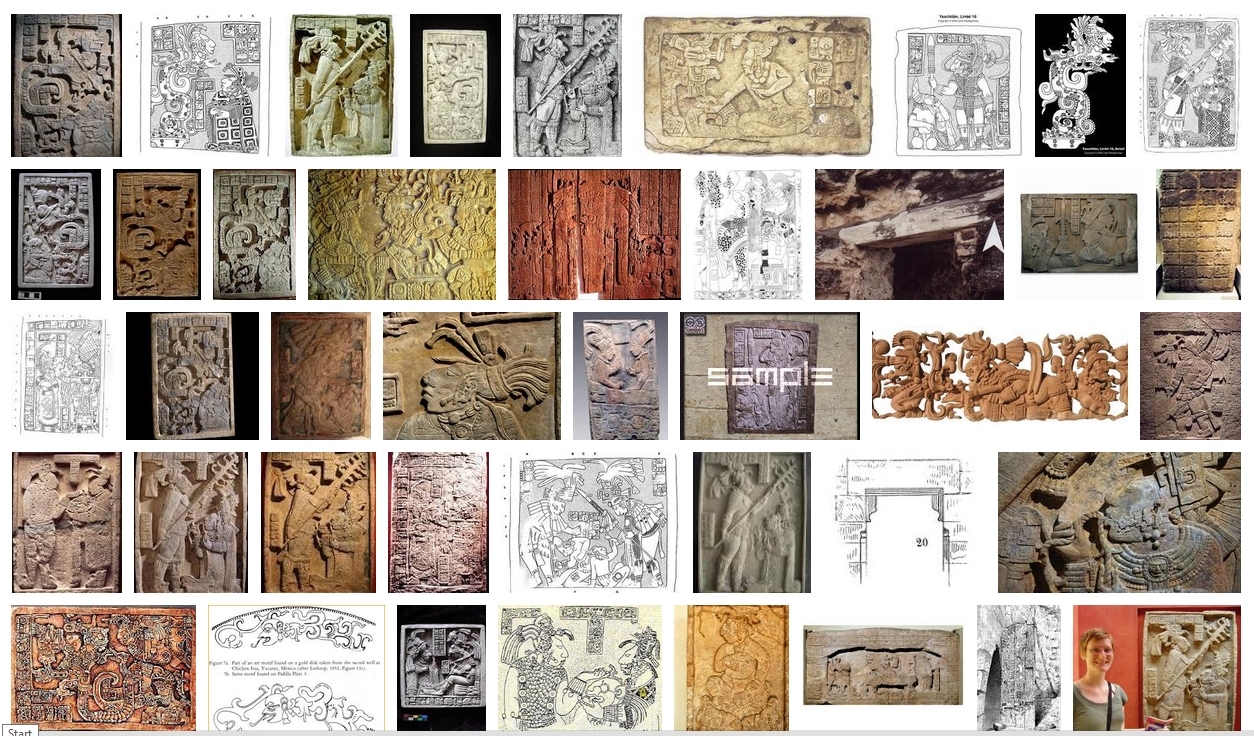
| Example Lintel |
![]() |
| Example jade artifacts and burial goods |
![]() |
| Example Stela |
![]() |
| 3D Map of Tikal (Tikal = Hawawa Complex of my 4e game) |
Saturday, December 29, 2012
Christmas Loot DM's Notebook
My wife listened to me well and got me an awesome present this Christmas. She bought me two really nice large blank unlined hardcover notebooks with sturdy bindings to use for my DM's notes. She got my name inscribed on the front and a dark brick red cover that reminds me of some old textbooks I have. I usually scribble my notes in random lined notebooks, on graph paper or in art notebooks. None of those typically hold up well in my backpack as they are used heavily for a year. My usual DM's notebooks are a tattered wreck by the time I fill them up and move on to the next one. These feel really solid, the binding looks great and the book opens up rather nicely.
The stats: 168 pages, cover dimensions: 13 3/4" x 9 1/8" x 7/8", inside page dimension: 13 1/2" x 8 7/8"
Here is the new book open to my first page of notes, with my other active notebook of standard size paper open on top of it for comparison.
Here is the book closed with the regular notebook closed for comparison.
Here is the binding from the outside.
After I fill up these two she is going to buy me new and different ones, so from here on out I will have an awesome collection of my DMs notes, well bound in sturdy hardcover.
The stats: 168 pages, cover dimensions: 13 3/4" x 9 1/8" x 7/8", inside page dimension: 13 1/2" x 8 7/8"
Here is the new book open to my first page of notes, with my other active notebook of standard size paper open on top of it for comparison.
Here is the book closed with the regular notebook closed for comparison.
Here is the binding from the outside.
After I fill up these two she is going to buy me new and different ones, so from here on out I will have an awesome collection of my DMs notes, well bound in sturdy hardcover.
Friday, December 21, 2012
Let it fly for all to see
One of my favorite DMs tricks is to make a quick decision as to the probabilities of some possible outcomes facing the party and then convert that into a dice roll that I do in front of everyone, clearly stating the parameters of the throw before letting it fly. This is of course an alternative to simply deciding what happens and then narrating the events to the players. It is part of my collaborative world-building philosophy of DMing. Vocalizing the possible outcomes and throwing in plain view makes the moment of suspense as the dice roll across the table a shared moment between the players and the DM, instead of that awkward moment behind the screen as the dice are thrown and interpreted in inscrutable mystery. Plus it eliminates the compulsion to "cheat" and ignore the behind the screens dice throw :)
Often I introduce far worse possible consequences than I would have comfortably decided upon by fiat, cushioned by the unlikelihood of rolling that nat 20 for the outlier result. I have had d100 rolls to end the universe, and d20 rolls to blow up the entire party to smithereens. For the random rolls that contain truly horrific outcomes I delight in making a party member do the actual rolling. So you want to take the time-travelling hummingbird-masked sorcerer up on his dare and jump into the lava tube down to the magma chamber like he did? You plan to replicate the complex ritual he did with his bad hummingbird self as he fell and jump into an existence outside of time and space like he did? If you roll a 1 you are going to be dead with no possibility of a raise and all your equipment will be lost. You still have a chance to chicken out... roll a d20...
During the last session of the 4e game I run I had several out-in-public rolls involving a rift to the future and a robotic incursion into a sacred grove in a volcanic crater.
16 or higher, more of the future robot mining machine comes through the time rift, 15 or lower, it stays put.
10 or higher, the time rift to the future grows wider, lower than 10 it shrinks.
1-3, the robot dragonfly shoots a missile at Beautiful Bob, 4-6 at Hammer. (I like d6 throws for determining who in the party gets attacked. Always have.)
I am sad to say that I used my nightly d30 roll for the first example last session and did not manage a 16 or higher (to my chagrin).
Likewise I failed to roll a 10 or high on a plain ole d20 attempt at the second example.
Next time, my pretties!
Friday, December 14, 2012
One Disappointed Hobbit
I went to my first midnight movie screening last night, The Hobbit: An Unexpected Journey, with my wife, sister-in-law, and sister-in-law's fiancee. The experience itself was enjoyable and mildly exciting, with a long line stretching out into the parking lot even though we had shown up 30 minutes earlier than our screening time. We waited out in the cold with all the other excited midnight moviegoers. The staff of the movie theater was abuzz, all hands on deck, managers walking around in suits coordinating the lines, the popcorn machines hardly pumping out enough to satiate the hungry mob.
And then the movie happened. I didn't have high expectations after learning the story of the Hobbit had been split into three movies, but I was still very disappointed. I think my malcontent started the second the first of the "good looking" dwarves showed up, peaked with Radagast the Brown's entire run in the movie and then just sort of ended with a whimper when I could have given a shit if every one of the dwarves somehow managed to jump from tree to falling tree and finally skydive to the safety of the soaring eagles below or not.
There were highlights for sure, the beautiful landscape of the middle earth being chief among them for me. Gollum was beautiful to look at and matched my childhood imaginings eerily well. But the story they chose to tell here really was not the Hobbit that I remember.
I guess I will have to watch it again when it does not end at 3 AM and give it a fair shake.
![]() |
| "Good Looking Dwarf" Numero Uno |
And then the movie happened. I didn't have high expectations after learning the story of the Hobbit had been split into three movies, but I was still very disappointed. I think my malcontent started the second the first of the "good looking" dwarves showed up, peaked with Radagast the Brown's entire run in the movie and then just sort of ended with a whimper when I could have given a shit if every one of the dwarves somehow managed to jump from tree to falling tree and finally skydive to the safety of the soaring eagles below or not.
There were highlights for sure, the beautiful landscape of the middle earth being chief among them for me. Gollum was beautiful to look at and matched my childhood imaginings eerily well. But the story they chose to tell here really was not the Hobbit that I remember.
I guess I will have to watch it again when it does not end at 3 AM and give it a fair shake.
Subscribe to:
Posts (Atom)