Showing posts with label new world campaign. Show all posts

Wednesday, September 30, 2015

Bororo - Tribe

Bororo Indians of the Amazon

I am currently reading Tristes Tropiques by Claude Levi-Strausse, coming to this book after reading his Mythologiques series, which introduced me to the Bororo.  English language Wikipedia is particularly uninformative on the Bororo, but I found some other websites and even some full text scholarly articles online that filled in some of the gaps from the Levi-Strausse reading.  I have an ongoing Google Document (shared below) that I am using as a research file, dumping links, sources and information into it as I read (I cite the source above the information gathered from that source -  some information  is paraphrased and some is direct quotation from the source material with some deletions/abridgment).  Here is the link: Bororo Research Document 


Quick RPG Takeaways:

The division of each Bororo village into 8 clans, four each in two opposing moieties (Cera and Tugare) makes for ready made inter-village tensions and adventure opportunities.  Despite a traditional hierarchy of the clans, each clan negotiates its own fortunes in each particular village and strives to gain more power in the form of access to new magic and clan roles.  I particularly like how each clan has unique/proprietary decorative ornaments and magical markings to use on weapons and as body paint.  I see each clan pattern bestowing a minor magical property onto the decorated spear, ornament or body (e.g. +1 to AC; +1 to hit and damage; double normal weapon range; +2 to STR; +2 to DEX; +1 attacks/2 rounds; cast a cantrip 3x/day; cast a 1st level spell once/day; etc.).  Bororo believe in reincarnation as part of a complicated transmigration of souls (Bororo souls also pass into animal bodies after death and before returning in reincarnation to a new human body).  Each Bororo shares the name of and is thought to be a partial reincarnation of a dead ancestor.  I think encountering "normal" animals with a Bororo transmigrating spirit could be fun (perhaps human intelligence and one or two minor magical powers for these animals), and then meeting the same spirit reborn into a young Bororo could be good fuel for gaming.

Bororo Encounters:

PCs will either encounter the Bororo out in the jungle/on the river, or at the Bororo village. The Bororo spend more than half their time on average outside of the village.  

Roll 2d6: 2-7: Encountered in Village; 8-12: Outside of Village  (Wet Season add +1 to the encounter roll during the beginning or end of the wet season, add +3 during the peak; during the peak of the wet season bororo spend most of their time on higher ground away from the village)

8-12+ Results: Outside of Village (more common in wet season)


  • 7-8: Hunting (more men)
  • 9-10: Farming/Gathering (more women and children)
  • 11: On the River (more men)
  • 12+: Walking through the forest to a faraway destination (equal sexes/ages if visiting friends/relatives, more men if raiding).  

Clans encountered outside the village = one or two of eight unique clans, each clan with its own: proprietary names; tribal roles; magical decorations/signs on weapons and utility tools; magical stories and songs; personal adornments/body paint.  

# Encountered outside the village = 2d6 (6's explode, add +1 clan per 12 encountered, e.g. three clans represented if 13-24 Bororo are encountered outside the village, 4 clans if 25-36 encountered, etc.)

Bororo Village

(The following largely after Levi-Strausse):

A typical village plan:


The village will have at least one hut representing all eight clans, and it is more common to have several huts per clan, representing sub-lineages of the clan.

# Houses per Clan (d6): 1: 1; 2-3:2, 4-5:3, 6:4

# Encountered per House: 2d6 (3d6 during village feast or clan ceremony)

Quick Village Population guide: Large: 300 Average: 150  Small: 100


The village is divided in two by an imaginary line between the Cera moiety to the north and the Tugare moiety to the south. Clan houses form a ring around the men's house in the center of the village. The central plaza is the bororo. Many important rituals are regularly performed in the bororo, especially funerary rites which can continue for months after a death.

The four Cera clans are arranged across the north end of the village circle, from east to west as follows: badegaba cobugiwu (upper chiefs); bokodori (large armadillo); ki (tapir); badegaba cebgiwu (lower chiefs).  

The four Tugare clans are arranged from west to east as follows: iwaguddu (the azure jay); arore (larva); apibore (acuri palm tree); paiwe or paiwoe (howler monkey). 

Moieties and clans are exogamous, matrilineal and matrilocal.  When a man marries he crosses the line separating the two moieties and goes to live in the hut belonging to his wife’s clan.  But in the men’s house he continues to have his place in the sector assigned to his own clan and moiety (his mother’s clan/moiety). The men’s house internal arrangements mirror the village at large - to the north the Cera men and to the south the Tugare.  

Clans are divided into subclans and lineages.  Each clan is ranked and certain positions in the village can only be held by members of particular clans (e.g. Village chiefs must belong to a clan of the Cera moiety).  Each clan has unique emblems, privileges and taboos related to the technique and style of manufactured objects, as well as proprietary ceremonies, songs, proper names and access to medicinal plants (e.g. Tobacco is associated with Bokodori clan, other aromatic plants smoked in a similar fashion include an anonacea controlled by the Paiwe clan).

Men cannot talk to women of the other moiety in public - even husband and wife would not bandy about in public, only being seen together in public when they leave the village to hunt, fish or gather together (which is seen as private).  


 Clothing/Personal Appearance:  Men are usually naked except for penis sheath, but sometimes (and always on festive occasions) wear elaborate ornaments made of fur, multicolored feathers, or bark painted with various designs.  Women wear a slip made from white bark (black when they are unwell) and a high girdle/corset, also made of bark, but dark in color.  Feminine ornaments consist mostly of cotton straps colored with red urucu, and of pendants and necklaces made from jaguar’s fangs or monkey’s teeth, worn only on feast days.


Wednesday, April 23, 2014

Lost City of Eridu (Early Temple Period)

Up until 50,000 years before the present day of my new world campaign, the landscape of the new world was considerably different.  A basalt ridge left behind from a volcanic eruption and lava flow in the distant past divided the drainage basin of the jungle roughly in half, and what are now the two main tributaries of the Zamonas were separate rivers, the Maita to the north and the Ilyapa to the south.  The Maita fed into an immense coastal swamp, while the Ilyapa snaked through the southern hills before going underground and flowing through a series of lava tubes to the coast.

50,000 years ago a great rock demon of tremendous power was drawn forth from under the highest volcano in the range by a powerful sorcerer.  This was in the time of heroes when many men had great powers that rivaled the gods.  Still, Asag was nearly invulnerable to magic and harbored a great hatred for it and he boiled the blood of the sorcerer with his presence, killing him instantly.  The sorcerer's name has been lost but all the cultures of the jungle basin remember when Asag came smashing through the basalt ridge almost all the way to the coast, exploding it in a shower of lava as he went.  Much of the northern swamps were covered in a lava flow and a good portion of the central jungle burned. When Asag's wrath began to cool in the surface air he returned to his kingdom under the mountain, and the Maita and Ilyapa rivers flooded the wreckage left behind and formed a new river, the Zamonas.  The entire jungle basin was now drained by this one great river.

One of the earliest city states (~30,000 YA) to arise in the region was Eridu, situated along the banks of the Zamonas where it flowed nearest the southern hills.  The patron deity of Eridu was Marduk the Sun, whose avatar had been persuaded to reside in a large gold statue and led the Eriduan people to many military victories.  The priesthood of Marduk in Eridu grew extremely wealthy and influential, and many of the religious traditions that characterize the early temple period  first arose in Eridu, including the proliferation of many specialist priest types.  Priests for the purification of the temple (masmasu), priests to appease the wrath of the gods with song and music (kalu), female singers (naru), male singers (zammeru), swordbearers (nas patri), masters of divination (baru), penitents (sa'ilu), priests for individual purification against demons and magicians (asipu) and the supervising or watchman priests (sesgallu) who served as mouthpieces of the God-statue - these and other specialized aspects of the priesthood that arose in Eridu soon spread to the other fledgling city-states and the early temple period proper (25,000-20,000 YA) starts with the adoption of the stepped-pyramid or ziggurat as home of a patron god-statue in all of the city-states of the coastal region.
Typical early temple period ziggurat: god's house in blue at the top
 holding the god statue inhabited by the patron deity's avatar  (25,000 - 20,000 YA)


The demise of Eridu came about in the middle of the early temple period, around 22,000 YA.  Eridu was left literally high and dry when the Zamonas  changed course and formed a new path to the sea hundreds of miles to the north.  Not long after, Asag was summoned to the surface world again by a powerful sorcerer who dangled himself and his arcane energy as bait in an attempt to use Asag against an amassed army.  Asag laid waste to the greater part of the jungle basin, annihilating all life in his path.  A delegation of sesgallu priests from all the affected city-states met to take action against Asag, and it was decided that Asag must be summoned and bound with divine energy to prevent him from ever raging across the jungle again (Asag's magic resistance only working against arcane magics).  The priesthood of Marduk from Eridu saw an opportunity to stay relevant and offered Marduk's assistance to bind Asag inside the metal pyramid of the sun in Eridu.  This proposal was accepted, and with the power of Marduk and his consort Sarpanitu the moon goddess, Asag was summoned and bound without loss of life.

Unfortunately for Eridu, Asag proved incredibly powerful once he had gathered himself and Marduk and Sarpanitu had to devote all their power to keeping him restrained.  Marduk's golden statue no longer strode at the head of the Eriduan army.  The name of Marduk no longer kept evil spirits and demons at bay in the night.  The people of Eridu revolted against the priesthood, accusing the sesgallu of betraying Marduk by forcing him to summon and bind Asag.  The priesthood stayed behind in the ceremonial complexes while the people of Eridu migrated to the coast.  Some people of Eridu married with the tribes of the southern jungle; men of these lines kept alive the secret cults of Eridu while women of these lines have passed on memory of Sarpanitu and still access the sacred moon grottos underneath the temple of the moon to conduct ceremonies in her honor.

The bulk of the people of Eridu made their way north along the coast toward the new mouth of the Zamonas where they had been promised land to farm near the emerging city state of Siss-Anor.  Shortly before the Zamonas changed course, the old fishing city of Anor-Anor had been sacked by foreign invaders called the Siss, led by sorcerer kings.  A new city known as Siss-Anor was built on the rocky outcropping above the ruins of the old city.  When the river changed course it flowed right up to the basalt outcropping of Siss-Anor, instantly making the city a new power in the region. When the people of Eridu neared Siss-Anor they were ambushed by a Siss army.  All the men of Eridu were killed and the women and children taken as slaves to work the fields.  Siss-Anor grew wealthy on the backs of Eriduan labor.  The women of Eridu in Siss-Anor also kept alive the knowledge of the moon cult through the ages.

After hundreds of years the priesthood eventually died out and the old city of Eridu and the sacred complex of the pyramids of the Sun and Moon were completely abandoned.  Marduk and Sarpanitu continued to bind Asag in the metal pyramid, locked in an eternal struggle.

Toward the end of the middle temple period, a sorcerer discovered that Asag was still bound under old Eridu and attempted to draw him forth.  The sorcerer was killed by cultists of Sharur, one of the old cults of Eridu still kept alive in the southern jungle, but the magic he had already set in motion made the metal temple of the sun glow so brightly it lit the night sky of the jungle like daylight.  A delegation of priests from the city states was called together and they summoned a landslide from the south hills that buried the old city and its pyramids.  All the way to the end of the late temple period (up to 10,000 YA) each city state offered a tribute of warriors and priests to guard the site against trespassers.  This tradition did not survive the upheaval that marked the beginning of the modern temple era, when the Siss gods of Siss-Anor replaced the old gods throughout the region and all the old temples were destroyed.  The cult of Sharur still persists and watches the site, and the moon cult of Sarpanitu is still active, the grottoes of the moon accessed through a larger cave network that they are connected to by a submerged passage.

Friday, April 4, 2014

Never Split the Party

There is an old maxim in D&D: Never split the party.  You usually hear this from the player perspective, in the context of survival advice.  Just like a horror movie, as soon as you wander away from the party you are going to be the first corpse.  United we stand, divided we are strangled by measles whilst taking a shit.  Keep the magic users in the middle.  Hi diddle diddle.

Of course there is a meta game reason to not split the party as well - the game runs smoothly when all the PCs are in one location, but  as soon as they separate, the DM has to run each group through its actions separately and track time for each group.   Temporal anomalies are a very real problem that you run into when you split the party - Bill and Ted spent eight excellent hours sleeping in the inn before going to the future, but in the meantime Beavis lit Butthead's fart on fire and burned down the inn.   Usually a handwave back in time is enough to fix these sort of problems (umm, actually Bill and Ted, you guys didn't sleep through the night, you were awakened in the middle of the night to panicked commotion in the hallway and the smell of smoke, so what would you have done then?).  If all the party members are each doing their own thing, at a certain point it would make more sense to stop playing as a group and start playing a bunch of interconnected one on one campaigns.  Which actually sounds pretty cool, but it isn't really D&D as most of us understand it to be - a group experience.

I personally have no problem with splitting the party as a player or DM.  The players in my new world campaign have made a lot of the traditional problems with party splitting obsolete anyway.   All the PCs have a permanent telepathic link of unlimited range (this was created about two years real time into the campaign using the telepathic energy technology of the alien spacecraft that Tilia found on the moon) and can teleport to each other's side or back to the hovercraft as a minor action (they found a bunch of matched teleportal coins, pairs of matched gold coins that when activated open a portal between the two coins - each PC carries a coin linked to a coin carried by another PC, and each PC has a coin linked to a coin on the hovercraft, as well as coins to some other locations that the PCs have sprinkled around the campaign landscape).

While this solves many of the traditional problems of splitting the party, we have found ways to split the party into a more psychedelic fractal gamescape than I could have possibly imagined when this campaign began.   For starters, we have been exploring the idea of splitting your consciousness into multiple copies for quite some time.  I actually first introduced the concept in my (now defunct) Mutant Future game* when the PCs learned that a recurring villain, Julius Corple, had made multiple copies of his consciousness that inhabited a "space" called shadow, the "place" that energy "goes" when it flickers in and out of existence (although shadow is not a space or a place, and exists outside of time as perceived in the PCs universe, and energy particles don't so much travel through shadow as become it). Julius Corples' shadow consciousnesses could create seemingly magical effects by manipulating the way energy was structured in the Mutant Future reality, changing its form in shadow, outside of time.  I have a unified theory of magical physics that I use in all my games regardless of system, and I allow exploration into and manipulation of magical physics outside of the normal D&D structure of spells, ritual magic and powers.  My new world campaign is run using 4e rules, but of course shadow lies outside of the realm of 4e rules.

Fast forward to the present, four years into the campaign, and the last few sessions have been a "never split the party" purist's nightmare.  One of the three main PCs did not even play at all last session, even though his player was in attendance and running two NPCs!  Here is an outline of how the party was split up going into the beginning of last Tuesday's session:

Tilia A:  Underneath the ruins of lost Eridu, between the first dungeon level of the temple of the moon complex and the surface, earthswimming with Hammer back toward the sacred lake to get a badly needed full heal from the holy waters (*not* psychically connected to the party's healer Beautiful Bob, who intentionally severed the link before going to sleep) .

Tilia B: [not active this session] surfing through deep shadow, retaining sanity because she is merged with a shadow dragon, in the middle of a subjectively centuries long mindfuck of a trip through the multiverses as the shadow dragon rides potential energy connections [note - Tilia split herself in two and Tilia B has already rejoined with Tilia A in Tilia A's timeline, but Tilia B is still an active game PC that we will revisit in future sessions to explore more about the nature of deep shadow and the way that energy is connected through the multiverses]

Hammer:  Earthswimming with Tilia back toward the sacred lake to get a badly needed full heal from the holy waters (*not* psychically connected to Beautiful Bob, who intentionally severed the link before going to sleep).  Hammer is a barbarian.  He doesn't split himself up.  Can he split something else up with his axe?

Beautiful Bob A: [not active this session] Hundreds of miles away in a cave in the swamp north of Siss Anor, in the middle of the horrific nightmares that are a withdrawal symptom of the psychotropic plants he consumed to aid in a ritual several sessions earlier.  A Nur-Kubi shaman (kind of like a reptilian praying mantis anteater psychic vampire,  the first sentient race released into the world by the snake man scientists) is siphoning off and feeding on the negative energy.  Bob A intentionally severed his psychic link with Tilia, Hammer, Nur-Kubi, Zanninum, Beautiful Bob ∞ Beautiful Bob C before going to sleep, worried that the psychic energy that might be released in his nightmares could damage them (Bob A was supercharged with nightmare energy, having taken on the nightmares of the four million plus souls trapped in Mother Mind three sessions back).  The session before last we advanced Bob A through several nightmare skill challenges, representing two full REM cycles of sleep, so we began last session needing to advance Tilia A and Hammer about 3-4 hours through game time before Bob woke up from his nightmares and re-established his psychic link with Hammer and Tilia.

Nur-Kubi the Cambion/FAKE Beautiful Bob [NPC controlled by Beautiful Bob's player, no psychic link to Tilia or Hammer]  Guest bedroom in Lady Mirriam's compound, the old temple of the moon in the ruins of old Eridu.  Nur-Kubi is assuming the appearance and demeanor of Beatiful Bob per Bob's commands.  Nur-Kubi begins the session fifteen minutes in time behind Tilia A, Hammer and Zaninum.  Lady Mirriam made a show of dismissing her handmaidens to the courtyard to watch out for any soldiers still angered by the party's actions of the day before (another story) and has shown Nur-Kubi/FAKE Beautiful Bob where her bedroom was and made it known that she would like him to visit her.  Nur-Kubi is waiting a few minutes after his companions have settled into their adjoining rooms before strolling down the hallway. Nur-Kubi is behind Tilia and Hammer in time because the session before last, Tilia earthwalked through the floor of her bedroom and encountered some cultists of the Nameless One in the first dungeon level below and got in a fight.  Hammer teleported to her side and they eventually killed the three lower level weretoad cultists and their higher level vampire leader, but not before sustaining serious wounds, expending a lot of powers and advancing their timeline past Nur-Kubi's.

Zaninum the Cambion  [NPC controlled by Beautiful Bob's player , no psychic link to Tilia or Hammer]  Just been spotted by the guards stationed around Lady Mirriam's compound (the old temple of the moon), was trying to stealthily make his way toward the sacred lake for a badly needed full heal after nearly being killed by an intelligent talking mace that could transform into a winged lion that he found last time while skulking around the ruins of old Eridu.

Curious George the hovercaft [NPC intelligent magical item hovercraft created by the party in dimension X using materials from that dimension] Circling high above the jungle, keeping an eye on things.  Psychically connected to Tilia and Hammer (and usually to Beautiful Bob but not currently until Bob wakes up from his nightmares).

Beautiful Bob B [not active this session] surfing through deep shadow, retaining sanity because he is merged with a shadow dragon, in the middle of a subjectively centuries long mindfuck of a trip through the multiverses as the shadow dragon rides potential energy connections [note - Bob split himself in two and Bob B has already rejoined with Bob A in Bob A's timeline, but Bob B is still an active game PC that we will revisit in future sessions to explore more about the nature of deep shadow and the way that energy is connected through the multiverses - also Bob B is connected to Beautiful Bob ∞ and Beautiful Bob C]

Beautiful Bob ∞ [not active this session] Beautiful Bob split his consciousness up into a near infinite number four sessions ago in a shared dream with Maricanchi, an NPC dreamer from the future. Maricanchi will be an extraordinarily powerful dreamer and split into a near infinite number to show Bob the dreams of the past, present and future inhabitants of the campaign world simultaneously.  [note - I gave Beautiful Bob's player an at will power called The Eternal Moment which allows Beautiful Bob A to connect with the infinite dreaming consciousnesses and learn more about the dreams shown to him by Maricanchi whenever he wants during play.  The only answers that he can get are what the people in the past and future are dreaming, not necessarily the reality of what is happening in the waking world in the past or future]

Beautiful Bob C [not active this session]  In the far future of the campaign world.  One of the many Beautiful Bob ∞ dream consciousnesses has traveled inside the Dream Machine that Maricanchi and his triplet brothers are hooked up to in the future.  The Dream Machine is a complicated piece of magic future technology that is somehow using the dreams of the three triplets to alter reality.  Beautiful Bob C has managed to retain his consciousness while leaving the dream world and taking the form of a single particle of energy inside the dream machine.  Two sessions ago Beautiful Bob C managed to break free of the regular energy routing inside the machine and did not go where the machine was sending his particle, instead choosing to explore the circuitry of the machine on his own terms  [note - we will definitely come back to what Beautiful Bob C is up to inside the dream machine because the dream machine is directly connected to the mind of Manu Jablitu, the technomancer lich who the party would probably consider to be the main bad guy of the campaign at this point over the snake men]


* all three of the current players in my new world campaign were also players in my Mutant Future game.  Those two games ran concurrently for quite some time and PCs from the Mutant Future game even briefly looked through a portal into my new world campaign but did not choose to go through it.

Monday, November 25, 2013

A Time Traveling Seed Sprouts

Back on December 29th of last year we played a session where the PCs had traveled back in time 4 million years before the current timeline to confront a time traveling sorcerer in a hummingbird mask and bright feathered cloak from creating a set of dark artifacts.  During this encounter Tilia ended up entering a shared dreamspace with the sorcerer.  The hummingbird man acted like he had already met Tilia, and when pressed shared the story of how he first met Tilia (none of which had happened as far as Tilia's player knew).  He said that he had been trapped inside a dream after eating a black lotus flower as a young man, during which time he had many visions which ultimately led him to travel to the past to create these artifacts.  During his dream vision at one point he encountered a great dream demon boar which was consuming the dreams of the people of the jungle with a greed and a hunger that could not be filled.  He was attacked by the dream demon boar, but a great white horned beast (Tilia) intruded and said many confusing things that he did not understand but which later he took to mean that he must travel back in time to make a set of artifacts that could be used to manipulate waking reality while in dreamland.  He said that Tilia had shown him one of the artifacts and told him of the others.  This was all very confusing for for Tilia's player who had no idea what I was talking about.  In the end though they wound up trusting the sorceror and allowed him to create the artifacts.

Well fast forward almost a full year of real life and Tilia finds herself back in the present timeline and in a shared dream within a massive collective consciousness known as MotherMind.  A dream demon boar has invaded the dreams of MotherMind and is causing greed and hunger where Tilia had tried to create a peaceful dream of the happy hunting grounds to calm down MotherMind.  Tilia suspects that the young man version of the hummingbird sorceror is also inside this shared dream.  At the end of last session Tilia was about to track down the young sorcerer and interrupt his encounter with the dream demon boar.  It will be up to Tilia if she wants to tell the young man to create the artifacts or not, but the present version of Tilia does possess one of the artifacts so if she doesn't I guess there will be changes to the present timeline :)

Of course, this isn't the first time the PCs have messed around with timelines.  The first was a journey back in time to prevent the birth of Slotek, the twisted son of Akili (Old Man Gootie's wife) and the great river spirit of the Zamonas River.  They did this hoping that if they prevented Old Man Gootie from corrupting Akili and creating Slotek that the great spirit of the river would instead be reborn in the form of a river dragon as the river dolphins had told them was supposed to be the natural order of things.  Of course, I used this event as a great excuse to make all kinds of crazy changes to the present timeline of the 4e game, although the players didn't find out about them for a while.  Ultimately this led to the river spirit being fractured into multiple deities each with an avatar in the river basin. 

The second time they messed around with time was a trip to the future, which is much less problematic in terms of not disrupting the present.  They traveled into the far future of the 4e world in pursuit of a time travelling vampire (emerging into an alien spacecraft on the surface of a dead world in the process of being consumed by an expanding dying sun).  After they killed the vampire and took his stuff, they became very intrigued by a magical artifact he was carrying.  Using a ritual to look into the artifact's past, they observed its creation by a strange sorcerer in a hummingbird mask and colorful feathered cape... ultimately proving to be irresistible to the party, so they time traveled to the past to begin this post :)


Monday, November 11, 2013

Near TPK in my 4e game

Last Tuesday's installment of my 4e game ended with our heroes in very perilous straits.  We ended the session with Beautiful Bob the half-gibbering mouther psychic (Ardent) and Hammer the warforged barbarian both below 0 HP and surrounded by snakemindflayers, presumably about to have their intelligences consumed.  The party's other member, Tilia the albino minotaur warden, had previously merged her body into the giant honeycomb mushroom brain that the snakemindflayers worshiped and called MotherMind.   At the end of the session Tilia had entered a lucid dreamstate to attempt some psychic healing on MotherMind.  Tilia was trying to sooth the nightmares of MotherMind and she called upon the energy of Bob and Hammer (with whom she shares a permanent telepathic link that was forged with alien energy technology some time back) to help her.  Bob and Hammer had both just dropped below 0 HP that round and lost consciousness so I gave them the option of joining Tilia in the shared dream when she called upon their energy.  They both took me up on that, so we will start next session with all three PCs in a shared dreamscape with MotherMind.

A few notes on how we got into this predicament:

*  The party allowed themselves to be led to the caverns of the snakemindflayers by a guide, knowing the entire time that the snakemindflayers wanted Tilia to merge with the MotherMind to fulfill an ancient prophecy about a white cow that featured prominently in the snakemindflayer religion.  The party had also gleaned that the snakemindflayers intended to kill the rest of the party and consume their intellects.

* The previous session, the party had initially parlayed with the first few snakemindflayers that they ran into... until suddenly jumping them and massacring them in one round.  For some reason the party decided to take a five minute rest in the same cavern that they just fought in, apparently deciding that no alarm had been raised despite knowing that the snakemindflayers and the mushroom men thralls that they had just killed had a psychic connection with MotherMind.

*  When the party's five minute rest was interrupted by a legion of approaching snakemindflayers and thralls, they decided to confront them rather than attempt to flee (although to be fair the only obvious direction to flee would have been deeper into the caverns of the snakemindflayers and toward MotherMind).

*  Faced with overwhelming numbers the party willingly marched with the snakemindflayers deep into their living mycelial city and Tilia willingly merged herself with MotherMind.  At that point the rest of the snakemindflayers politely asked Hammer and Bob to accompany them back to the ritual sacrifice chambers so they could fulfill their destiny of being consumed.  Hammer and Bob didn't want to comply.

*  The party soon learned that the metallic rods that the snakemindflayers all carried were some kind of technological laser weapon.  Hammer learned that getting shot with lots of lasers hurts.


Tuesday, October 1, 2013

Nur-Kubi and Zaninum the Cambions

This is a post for the benefit of my players, so they have the stats of the two cambion NPCs they now control.  I based these off the Cambion Wrathborn and Chained Cambion, but I bumped up the HP, defenses and damage expressions because my players are 23rd level at this point.  These cambion were meant to be an annoyance in combat with the PCs while their sorcerer master flew around above them and caused problems; of course when it came down to it the party thrashed the sorcerer pretty quickly while Beautiful Bob rolled a natural 30 on his once nightly roll on  the d30 in an attempt to dominate the two surviving cambions (he has an ability to attempt to permanently dominate bloodied opponents, I believe he gained this ability by consuming the soul of an inquisitor devil that he had trapped in a malevolent nut a while ago).  I usually wouldn't have let him dominate the cambions because they were sired by the sorcerer the PCs were fighting, but if you roll a natural 30 on a d30 you succeed in whatever you are trying to do.  That is why Beautiful Bob is half-gibbering mouther as well, he rolled a natural 30 in attempting to psychically befriend a gibbering mouther in his very first session and then he later combined his own form with the mouther in a dark ritual.

So anyway, Beautiful Bob now has two cambion NPCs, Nur-Kubi and Zaninum (both fathered by Mezizi Al-Bado, member of the royal sorcerer's Order of the Phoenix and secret member of the order of the Horned Skull - their mothers are two different succubus devils).

Nur-Kubi is a shifty sort who prefers to assume human guise and dislikes it when he loses control and must assume his natural, fiery winged form.  He wishes he were human. He despises devils and his half-brother Zaninum

HP: 200       Bloodied 100                          Initiative: +15   Perception: +12  Darkvision
AC:33  Fortitude:31  Reflex: 34  Will: 30
Speed: 6, Fly 8 (clumsy)
Resist 10 fire

Traits:  Burning Anger (fire): Aura 1 - while Nur-Kubi is bloodied, any enemy that ends its turn within the aura takes 10 fire damage.

Standard Actions:
Pain Blade (weapon) at will: melee 1; +30 vs. AC  4d8+16 damage and the target grants combat advantage until the end of Nur-Kubi's next turn.

Path of Pain (weapon) at-will: Nur-Kubi shifts 4 squares and uses pain blade at any point during the shift.

Fire Bolt (fire, implement) at will: Ranged 5 +28 vs Reflex 4d6+10 fire damage

Burst Skyward (fire, implement) Encounter: Requirement: Nur-Kubi must be bloodied. Close Burst 2 (enemies in burst); +30 vs Reflex 4d10+10 fire damage and Nur-Kubi flies 8 squares without provoking opportunity attacks.

Minor Actions: Wicked Guise (illusion) at will - Requirement: Nur-Kubi must not be bloodied.  Nur-Kubi can assume the appearance of a specific Medium humanoid.


Zaninum  is an angry sort, full of hatred and wrath.  He loves killing things.  He hates humans.  He thinks his half-brother Nur-Kubi is weak but envies his ability to fly.  He wraps himself in chains that he can control telekinetically.

HP: 220       Bloodied: 110                             Initiative: +15  Perception:+15   Darkvision
AC:34  Fortitude:32  Reflex:30  Will:30
Speed:6

Traits:
Binding Chains: Aura 3  Squares within the aura are difficult terrain for enemies

Child of Chains: While immobilized or restrained, Zaninum gains +2 to attack and +2 to escape a grab or to savings throws against immobilization or restrain.

Standard Actions
Chain Lash (weapon) at-will: melee 3 +32 vs. AC  6d6+16 damage and a dazed target is immobilized (save ends)

Vile Fetters (psychic) at will: melee 5 +30 vs. will  4d6+12 psychic damage and if the target ends its next turn closer to Zaninum it is dazed (save ends)

Unfettered Scream (psychic) recharge 5,6: Close blast 3 (creatures in blast) +30 vs. Fortitude 4d6+12 Psychic Damage and the target is pushed 2 squares and dazed (save ends)

Minor Actions
Mind Shackles (psychic) Recharge when first bloodied:  Two enemies adjacent to each other in a close burst 5 are psychically shackled (save ends; each enemy makes a separate saving throw against this effect).  While psychically shackled, an enemy takes 20 psychic damage at the start and the end of its turn if it isn't adjacent to the other creature that was affected by this power.  Aftereffect: the effect persists, and the damage decreases to 10 (save ends).

Siss-Anor Dungeons pt. 1

Last session in my 4e game the players were exploring the dungeons underneath the royal palace of Siss-Anor for the first time.  Magical wards prevented teleporting into or out of the area underneath the palace, so for the first time in a long time the party didn't have the safety net of being able to open a portal back to their orbiting spacecraft with their portal coins.  I am going to post some maps of areas of the dungeons, because by the end of last session Beautiful Bob had wrested control of two cambion (half-devil) slaves from a royal sorceror.  These two cambions are now totally loyal to Beautiful Bob, and they are intimately familiar with the areas of the dungeon occupied by the devil-pact Order of the Horned Bull as well as the network of passages and caverns that link from the order's temple to the ancient ritual caverns in the lowest level of the dungeons.  I am going to post some maps soon, but first some back story.

For the last few months of game time, the city of Siss-Anor had been oppressed by the snake men who suddenly arrived in their flying golden city/meteorite over the palace and activated sleeper cells of snake men loyalists within the royal family and royal inquisitors.  The royal bloodline of House Al Treez was revealed to be of snake man scientist creation - genetically modified to be susceptible to snake man telepathic command.  Squadrons of large humanoid lizardmen with green shadows instead of heads abducted most of the ranking leadership of both the other royal houses and the named merchant houses.  Unprecedented numbers of blood sacrifices were demanded of all the houses, and several resulting uprisings were put down with brutal efficiency by the legions of the snakemen.  Then just as suddenly as they arrived, the snake man city flew away upriver into the jungle and has not returned.

Without the backing of the snake men, the collaborators within the old royal government soon were besieged in the palace.  When the palace fell the old loyalists/snake man collaborators retreated into the dungeons below the palace.  The royal sorcerers, while not of snake man blood and in fact chafing under the new order, had not openly resisted the snake men and indeed had helped put down the uprisings.  A secret society within the royal sorcerers known as the Order of the Horned Bull had formed a pact with the lords of hell many generations ago, and they called upon the minions of hell to protect them as they retreated into the dungeons.  The upper level of dungeons, mostly consisting of barracks for the royal guard and extensive prison cell blocks, are now flooded with devils - at the moment keeping the forces of the uprising houses from capturing the collaborators.

The party has a man on the inside, a member of the royal family and a royal inquisitor himself, Kaaz al Treez.  Many sessions ago Kaaz allied himself with the party because he had been investigating secret plots of the snake men in the royal house of Siss Anor for quite some time.  He had been investigating a secret order within the inquisitors known as the Order of the Serpent.  This secret order passed down the knowledge of the snake men for thousands of years, conducting rituals in hidden caverns far below the surface where a strange race of snake-mindflayers (snake man scientist creations) live in a network of tunnels honeycombing a sentient mycelial mass.  Even after the the snake man citadel left, Kaaz observed snake man scientist activity in the lowest levels of the dungeon where the snake-mindflayers live.  Literally taking the form of a fly on the wall, Kaaz observed a snake man scientist entering a secret doorway in the Cavern of the Blood Sacrifice.  Following the scientist in his insect form, Kaaz discovered a snake man scientist installation hidden underneath the caverns.  A large circular chamber was filled with the golden machinery inset with gem buttons and festooned with levers that is characteristic of the snake man scientists.  In the center, some kind of energy vortex or singularity danced suspended in mid-air.  Kaaz observed the snake man scientists walk directly into this energy vortex and disappear.  When Kaaz followed after a discrete moment, he found himself on a clear platform far above the floor of an immense chamber.  Hairless blue skinned humans and snake man scientists of unusual coloration busily crisscrossed the floor of the chamber to and from the eight archways ringing the chamber.  Something in the atmosphere felt wrong, and he had difficulty maintaining his insect form.  He was unable to communicate with the party from in this chamber through the magical wasp ear rings that he and Beautiful Bob wear for this purpose.  When he attempted to fly down into the chamber he lost his insect form and crashed into a far corner of the immense chamber.  He had difficulty using any magic at all and was unable to assume any of his tattoo forms.  Eventually he was able to figure out how to activate an elevator lift to take him back to the platform, where he stepped back through the energy vortex.  He contacted the party after this and told them the whole story.  He explained to the party how they could access the lowest levels of the dungeon through a long flooded passage connecting to the old sewers, and that is how and why the party came to be entering the Cavern of the Blood Sacrifice underneath the palace of Siss Anor last session.


Wednesday, September 18, 2013

Magical Circuitry pt.2

A while back I posted about my 4e players beginning to figure out how to assemble magical circuitry to create magical "machines" that functioned much differently from the magical items created through rituals in 4e.  Plants, organs from magical creatures and magical crystals and minerals could be combined to create magical effects.  This worked in a fairly straightforward manner; the blast cannons the party made from the legs of genetically-modified partially robotic giant insects and the dark organs of the larval spawn of an elder godcreature are an excellent example.

Next, the party figured out that magical energy could be transformed in the shadow world to enable magical machines to perform many more functions. They first learned about this by observing how shadow pearls in a magical shield constructed by the snake men scientists transformed raw energy and created both a repulsor beam to fly the shield as well as a laser to blast the crap out of things.  I want to post more about the magical discoveries the party has made since then, but first I need to lay out some cosmological groundwork.

In my game cosmology there is the physical world, the spirit world and the shadow world.  The physical world is a multiverse that I call the IPM (infinite possibility matrix) in my games (I use this cosmology independent of system - I used it for my 3e game and my Mutant Future game as well as the 4e campaign).  The main thing distinguishing the IPM from any other multiversal theory is the travel of energy between different possibilities. Imagine every particle of energy in the universe somehow "freezing" in time.  The planets and suns and comets stop zooming around and hang motionless, as do the electrons and protons and in turn quarks and neutrinos...  and if you zoomed in as far as you could on an individual unit of energy, in the IPM you would discover that the smallest unit of energy both does and does not exist at the same time.  In the frozen universe, outside of time, energy flickers in and out of existence.  It is travelling outside of time between the different possible universes.

If you could somehow follow the flow of energy outside of time between the different possible universes you would be in the shadow world.  The shadow world exists outside of time and the usual constraints on the forms energy can take.  It could simultaneously be thought of as an undifferentiated sea of energy, and as a sea of every form that energy could take.  If you followed a linear conception of time backward to the big bang, the shadow world is on the other side of the big bang if you kept heading "backward".

The spirit world is the borderland between the physical world and the shadow world.  There are as many spirit worlds as there are possible universes, but there is only one shadow world.  The spirit world is how/where energy leaves the universe to join the shadow world, and the spirit world is how/where energy returns to the universe from the shadow world.  The spirit world could be thought of as a veil that covers the universe and defines its bounds, even as energy flows to and from the universe through the spirit world into deep shadow and all other possible universes.  As energy constantly flows between the different probable universes, it is possible for networks of energy to simultaneously become sentient in the spirit world surrounding a universe.  Once such a consciousness arises, it persists even though the individual units of energy that make it up are constantly in flux.  These are spirits.  Different sorts of spirits arise in the different spirit worlds surrounding different possible universes.

Back to magical circuitry - every universe has rules that govern how energy can behave.  Anything that breaks those rules is magic.  The way that magic functions is to tap into the possible forms of energy in the shadow world and make energy returning to the universe retain these shadow forms.  The study of magic is the study of the potential forms of energy, how to tease out the desired form in the shadow world, and how to bring back that form through the spirit world.

Tuesday, August 27, 2013

Flying Saucer Deck Plans

There is the off chance that the players in my 4e game might end up exploring a high-tech spacecraft today of the flying saucer variety so I was Googling "flying saucer deck plans".  This old web page has the complete blue prints of a Constitution class Starfleet vessel, the top portion of which is basically a flying saucer (deck plans for this portion below).  The page also includes the contents of each level and a key for all the abbreviations.  The full ship is a mega-dungeon all gift-wrapped and ready to go :)  http://www.oocities.org/thinkexperiment/shiptour.html

Flying Saucer Deck Plans:


Wednesday, March 20, 2013

Snake Man Scientists and Servitors (part one)


Snake Man Scientist:  A four-armed sterile caste that occurred through random mutation shortly after the Prime genome was expressed from a clutch of Temple Servitor eggs on Celestia, the Snake Man Scientists propagate their species by cultivating the mycelial egg mats which hatch under the correct conditions.  Unlike the Primes who emerge from the egg in amphibious tadpole form, Snake Man Scientists burst from their eggs as a tiny version of their adult form.  Several molts are required before they attain their adult size, and the coloration of each of these molts identifies several juvenile stages.

Snake Man Servitor:  The result of many years of controlled breeding and experimentation by the Snake Man Scientists, the Servitors are bipedal, four-armed and covered in brilliant purple and violet scales.  The Servitors are an attempt to recreate the original Temple Servitor created race that served the pan-universal religions of the Celestian temple cultures.  Despite the origins of both Snake Man Primes and Snake Man Scientists as mutant variants of the Temple Servitors and the bloody rebellion that freed them from temple servitude, creating their own servitor race was a high priority of the Snake Men.  Ancient Snake Man Proverb:  Treat others as you would not desire to be treated yourself :)
Servitors are bred with a servile nature and an unfailing belief in reincarnation into Prime form upon death.  Servitors are quite intelligent and serve both as lab assistants to the Snake Man Scientists and ranged fire support on the battle field.  Unlike Snake Man Spawn (which are never outfitted with weapons or armor to denote their inferior status compared to the Prime and the Primelings of their line), Servitors wield blast cannons and wear energy armor into battle.

As a side note I stumbled upon this DeviantArt page by JGood8 which seems to contain drawings of the snake man scientists lifted directly from my cranium.  I figure if he can telepathically invade my mind like that, I can post his drawing here - at least I linked to him!  And I will gladly remove this picture if requested, but I had to post it.  This is EXACTLY what a 3rd molt juvenile Snake Man Scientist looks like, on the left in color:

Friday, March 8, 2013

Snake Man Spawn

Snake Man Primes constantly emit spores that grow into mycelial mats which produce fruiting bodies and ultimately tadpoles that eventually metamorphosize into the adult snake man form (see Snake Man Prime post).  These are referred to as snake man spawn to differentiate them from the Prime of their line.  Snake man spawn are marginalized and live in constant fear of being slaughtered by their own Prime or a Prime of another line.  When a snake man spawn is killed, all line allies within 50 gain a temporary +1 bonus to hit and damage until the end of the encounter (stackable up to +5 for other spawn, no limit to the bonus the Prime of the line can gain in this manner).  For this reason Primes enter battle in the middle of a vast convoy of their spawn, who lend their life energies to the Prime and their clone brothers even in death.  It is not uncommon at all to see a Prime cutting down swathes of his own spawn to get pumped up before a battle.  Spawn are not given battle armor or weapons, relying on the snake man martial arts (heavy on tail sweeps, knockdowns, strangulation, punches and elbows) and their deadly venomous bite in combat.
Snake Man Primeling

Snake man spawn have no rights or protections in snake man society, and are considered only barely above the created Servitor race that assist the snake man scientists.  Only if a spawn survives for long enough to be one of the 100 oldest spawns of the line, one of the next in line for Primehood, does it receive any rights at all.  The 100 oldest spawn of the line are referred to as Primelings and they are never allowed to be in the same vicinity as the Prime of their line, so that if the Prime falls the line will not fall with him.  Primelings begin to develop a tumor in the left shoulder that becomes the fetal twin sister that will awaken upon the Prime transformation.  Even though the twin remains nascent and unconscious until the Prime transformation, they do lend some psionic abilities and protection to the Primelings that sets them apart from the other Spawn of the line.  Primelings are also outfitted with magic armor and weapons in the style of their line. Primelings are trained in the snake man weapon arts by the Prime of another line.  Each line has a traditional relationship with another line that shares the same weapon style, the Primes of each line training the primelings of the other.  Killing a Primeling is considered a mortal insult to the Prime of the line, and a duel to the death between the Primes involved usually follows.

Wednesday, March 6, 2013

Snake Man Primes

Snake Man Primes are the warrior and dominant caste of snake men.  They only have male snake sexual organs.  There are 7919 lines of Primes, a number that has not changed since the original mutation in a batch of temple servitor eggs on Celestia birthed the species.

Each line has a Prime, the eldest living member of the genetic line.  When the previous Prime is killed (a Prime is effectively immortal and will not die of natural causes) the next oldest member of the line becomes the new Prime.  Only the Prime of each line can reproduce; upon achieving Primehood the four organ tentacles constantly emit spores that grow into a fleshy mycelial mat in the presence of energy and moisture.  These mycelial mats produce fruiting bodies with a water filled pod on top.  Connections through shadow to Shadow DNA (sDNA) cause mycelial tissue in a specialized node to turn into animal flesh and a tadpole is formed which swims up the stalk of the fruiting body and lives in the pod, eating algae blooms in the water if there is light present or pieces of the fruiting body itself which decay and fall off in the absence of light.  A fully grown tadpole bursts from its pod and wriggles to a dark place to metamorphosize into the adult snake man form.  Each snake man is an exact genetic clone of the Prime of its line with whom he shares a telepathic link of unlimited range.


When a snake man becomes Prime a set of genes are activated which cause a dwarf female conjoined twin to grow along the arm and left shoulder.  One eye opens in the palm of the left hand from which the female twin can see.  It takes many years for the newly developing female twin to achieve adulthood, and many more years to fully access the memory of the previous female twins.  A fully mature female twin has full access to the memories of all her clone-sisters before her.  Even newly forming female twins have powerful psychic abilities which add to the battle prowess of the Prime.  When a Prime raises its left hand in battle and the eye of the twin opens, enemies cower and flee.  Over long centuries the female twin's continued growth causes a hunchbacked deformity that saps the physical strength of the Prime even as the psychic powers of the twin continue to expand exponentially.  The lines of the Primes are ranked according to the longevity of the Prime of the line.  The oldest Primes are completely dominated by their female twins in normal life, existing in a kind of vegetable slumber while the twins hone their mental skills.  The 10 oldest primes have not stirred for over 20,000 years.  If roused the combination of deformed male Prime warrior and ancient female psionist would be perhaps one of the deadliest combatants in the multiverse.

Snake Man Biology Pt. 1 - Introduction

I introduced the Snake Men in my 4e campaign in Session Numero Uno through the wild tales of a swamp trapper who told of a "city made of gold" that he and his friends had discovered, which he claimed was inhabited by snake men.


A handful of sessions later the party was in an alien spacecraft made of pure energy and they were accessing the data logs of several linked satellites in stable planetary orbit.  In the course of observing several billion years of planetary formation they also caught a relative blink-of-the-eye in time highlighted by a meteorite slamming into the exact center of the formation of alien spacecraft, forming the depression now filled by the swamp.  Yes, the many minareted and domed city which stood on the meteorite was made of gold. A circular rocky ridge in the center of the swamp, thrown up by the impact, conceals the city of gold. Mushroom life sprouted across the meteorite shortly after the crash, and from the mushrooms sprang tadpoles which metamorphosized into snake men.  To the party's horror they discovered that all of the humanoid races of the planet had their origin as experiments released by the snake men scientists into the swamp.

When the party thought to look for the visual evidence of the swamp trampers finding the city, they observed two snake men meet the three trappers on the top of this ring.  A snake man held up its hand and two of the trappers disintegrated into dust.  The third trapper soiled himself as the other snake man grasped him solidly for a moment before releasing him.  The party's informant fled promptly.

Curious, the party kept investigating that moment in time through satellite footage and discovered that the outbreak of the white death plague could be reliably dated to shortly after the return of this swamp trapper to the settlement.

Several sessions later, the party had crossed the mountains and was exploring the verdant rainforest beyond.  They found an artifact of the snake man, a flying laser shield meant to be worn by a snake man warrior.  This shield revealed that the snake men had four small organs that could interact with four circular depressions on the inside of the shield, like four sensitive finger-tentacles that stick out of the snake man torso.

Using ritual magic to look into the shield's past, they watched its creation by snake man scientists, all of whom had four arms.  The scientists tended to mats of mycelial tissue which they grew in molds in the shape of the shield and many other items (I just realized that the use of the word "mold" in the sense of a 3-dimensional negative shape that you pour or push a substance into to form a sculpture could be confusing when the substance that fills the mold is mycelium!).  When the molds were full of mature mycelium the snake  man scientists activated a complex arrangement of pearls and gemstones that transferred energy through shadow and turned the mycelium into many different substances, gold in the case of the enchanted flying shield.  The discovery of this shield was the first step in the party's current understanding of how to manipulate energy through shadow, the foundation of a true understanding of magic.

When the party began to piece together the history of the city states of the great human civilization on the other side of the mountains they realized that the influence of the snake men had crossed that great natural barrier long ago.  They discovered the fingerprints of the snake men in the blood tattoo magic that raised their hackles.

Even Manu Jablitu, the ancient technomancer lich who has become number one on the party's most wanted list for quite a few sessions in a row now, was first encountered because his services were procured by the snake men to solve a dimensional instability.  A while back the players in my Mutant Future campaign discovered an alien installation in a strange dimension that had a machine in it containing the entire 4e probaverse in a controlled singularity.  A player running PCs in both campaigns looked at the machine and infamously said "I'll flip some switches".  I asked him to roll d100 and he rolled a critical failure "01".  As a result, the machine began powering down and the stars started going out in my 4e campaign and many monumental constructions of the ancients that drew their power from the stars no longer worked.  The snake men were pissed and Manu Jablitu was brought in to fix things, but interestingly the 4e party managed to stabilize the probaverse without resorting to reprogramming the machine like Manu Jablitu intended to do.  All Manu Jablitu has done since is rise to near mythological status as the party keeps encountering more evidence of the crap he has done in the past.  Much of which was done under the patronage of the snake men, evidently.

I bring all this up because last session Beautiful Bob used the psychic enhancing module in the radiant energy vortex that he was accessing from the energy bath of the lich Pay-Gon to split his consciousness into 16,000 pieces to simultaneously accept a telepathic information feed from the 16,000 intellect-equivalent crystal gas mind the party encountered.  It may take him a while to process, but Beautiful Bob actually received the entire genome of both the warrior or "snake man prime" caste and the four-armed scientist caste in this telepathic transmission from the crystal gas mind.

I plan to write several posts about the biology of the snake man now that the party would definitely know the ins and outs.


Saturday, February 9, 2013

Pai-Gon's Hexagonal Experiments

Poking around in the arch-lich Pai-Gon's work room whilst trying not to draw the ire of the incredibly powerful crystal intelligence bound into the tree of human arms flesh golem thing, some members of my 4e group decided to open up some random sealed ceramic containers.

Pai-Gon's Work Room


These containers were roughly cubic, with each face of the cube being a hexagon and some odd faceted angular faces making up the difference.  Each container was stacked six high with the sealed opening facing out into the room, in three rows six containers long.

Each container held one of Pai-Gon's experiments, left to bathe in the mutating and energizing radiation emitted by the Huwawa Complex after Pai-Gon mysteriously disappeared.

I made some random tables to determine the contents of each jar.  They proved to be very stimulating in play, causing quite a few "what the fuck" moments amongst the players as they had no clue what they were getting themselves in to.

Roll on each chart.  4e Plant, Animal or Insect refers to an organism native to the "prime material plane" or whatever you want to call the normal plane of existence that D&D is played in.  Planet X refers to an inhabited planet in another dimension/plane of existence that has a considerably different periodic table and physics.

Chart 1: Physical Environment inside the container (d20)
1-3: Fresh Water
4-5: Salt Water
6: Acidic Liquid
7: Basic Liquid
8-9: Acidic Soil
10: Ph Neutral Soil
11: Basic Soil
12: Silt/Inorganic Mud
13-14: Organic Mud
15-16: Clay
17: Solid Rock
18: Crystal
19: Metal
20: Metallic Gas (some heavy metals in Dimension X have a gaseous state)

Chart 2: Subject of the Experiment (d20 - containers with plants have a magical light source and magically regulated growing conditions, containers with animal and insect experiments also contain appropriate food species - many containers are much larger inside than their external dimensions would suggest)
1-4: 4e Plant (roll d10: 1-2: Fungus, 3-4: Flowering Plant, 5-6: Succulent Plant, 7-8: Bush, 9-10: Tree)
5-7: 4e Plant / Planet X "plant" hybrid
8-10: Planet X "plant" (roll 2d6: first d6: 1-3: Carniverous, 4-6: Chemosynthetic, second d6: 1-2: Mobile, 3-             4: Anchored but moving parts, 5-6: Stationary)
11-12: 4e Amphibian (roll d6: 1-2: Frog, 3-4: Toad, 5-6: Salamander)
13-15: 4e Insect (roll d6: 1-2: Crawling, 3: Jumping, 4: Digging, 5-6: Flying)
16-18: 4e Insect / Planet X "insect" hybrid
19-20: Planet X "insect" (roll d6: 1: Crawling, 2: Jumping, 3: Digging, 4-5: Flying, 6: Teleporting)

Chart 3: Broad area of Pai-Gon's interest that the experiment falls into (d20) (combine with subject matter and environment to determine purpose and exact contents of each experimental container)
1-2: Protection from Damage
3-4:  Controlling Agression
5-6:  Controlling Emotion
7-8: Protection from Fire
9-11: Love
12-13: Dispelling Magic
14-17: Plant Propagation
18-20: Insect Breeding
21-30: Shadow Plant Analogs (I put this entry in the chart because we use the d30 houserule - once a session replace any roll with a d30 roll.  What exactly a shadow plant analog is might be a subject for an entire post on its own I think)

Chart 4: Current State of the Experiment (d6)
1-3: Experiment existing in stasis and performing as designed by Pai-Gon
4: Stasis failed due to Huwawa field, contents destroyed
5:  The experiment succeeded but the intended results have run wild for thousands of years
6:  The experiment failed but a secondary organism in the controlled environment has mutated and thrived (flies included as food for a spider experiment might still be thriving, or a plant included as food for an insect experiment has mutated and taken over the container, etc.)

Obviously these charts are going to give suggestions of categories, not specific results:  It is up to the DM to interpret what an acidic liquid environment, Teleporting Planet X Insect experiment about Love that has succeeded but run wild means, exactly.

My party ended up with worms that burrowed through solid rock and consumed magic, a green gas spore cloud that left sickly mutant flowering plants springing up wherever the spores encountered moisture, a burbling pot full of mud with a fire-resistant salamander in it and a crystal matrix that served as an artificial growing medium for a Planet X insect grub.  Hammer the warforged barbarian opened the container of magic consuming worms, much to his disgust as he realized that they were consuming the very magical lifeblood that flowed through his constructed body.

Thursday, January 24, 2013

Huwawa Complex

The players in my 4e game are mucking around in a loose analog of Tikal (see this text and image dump post for some Tikal flavor) I am referring to as the Huwawa complex after the imprisoned godlike force that is bound below the lowest dungeon level.

 I used the central structures of Tikal for the surface layer, with a 3 level dungeon underneath.  I sketched the dungeon maps free hand in isomorphic view.  I added the graph lines by hand.  I was a little drunk when I laid down the original perspective lines and in many cases they vary wildly from true.

I scanned in the maps and messed around with them for a minute in Photoshop.  This first one is color coded by level depth: Blue = Level 1; Green= Level 2; Red=Level 3; and Yellow=Level 4 (the very surface layer of the imprisoned entity below the dungeon levels).

Now here is a map color coded by connections to the surface structures: Red = vertical connections with the Central Acropolis; Green = vertical connections with Temple II; Purple = vertical connections with the North Acropolis; Yellow = vertical connections with Temple I and Blue = vertical connections with the structures to the east of Temple I, which in my analog is another temple pyramid similar to Temple I and II.

The awesome thing is the party actually has architectural plans of the complex from the library they looted a few sessions back, so this post isn't even technically a spoiler!  Of course, the party managed to figure out a way to use the solid jade portals that only allow the dead to pass through them, so they have been teleporting all over the dungeon using the lich doors and they probably won't even end up seeing most of the place before they get the loot they came for or die trying.

Monday, January 7, 2013

Prep for next session

 Wiki Maya Death Rituals:

"The Maya dead were laid to rest with maize placed in their mouth. Maize, highly important in Maya culture, is a symbol of rebirth and also was food for the dead for the journey to the otherworld. Similarly, a jade or stone bead placed in the mouth served as currency for this journey. Often, whistles carved from rocks into the shapes of gods or animals were included in the grave offerings to help the deceased find their way to the spirit world. The Maya associated the color red with death and rebirth and often covered graves and skeletalremains with cinnabar. The bodies of the dead were wrapped in cotton mantles before being buried. Burial sites were oriented to provide access to the otherworld. Graves faced north or west, in the directions of the Maya heavens, and others were located in caves, entrances to the underworld.
Burial practices of the Maya changed over the course of time. In the late Preclassic period, people were buried in a flexed position, later the dead were laid to rest in an extended position. In the late Classic period, the elite constructed vaulted tombs, and some rulers ordered the construction of large burial complexes. In the Postclassic period, cremation became more common.

[edit]Tombs

There have been many archaeological discoveries of lavish tombs within ceremonial complexes from the Classic period. However, only a Maya city’s most important ruler was buried in this way. These aristocrats were placed in tombs at the bottoms of funerary pyramids that sometimes consisted of nine stepped platforms, perhaps symbolizing the nine layers of the underworld. Other temples were constructed with 13 vaults the symbolizing the layers of the heavens in Maya cosmology. These temples reflected the continued worship of these nobles. In some instances, members of the royal family or young attendants would be sacrificed to accompany the lord in death.
The tombs were filled with precious goods including fine polychrome pottery, effigy figurines, jade and marble pieces, masks, mushroom figures. While these figures were found in Maya tombs, many of these items were also used in the service of food, drink and for additional ritual purposes.[1] Obsidian and exotic shells have also been found in Mayan tombs.
Other elite members of society were buried in vaults. The bodies of higher-ranking members of society were buried inside sarcophagi. They sometimes were buried in crypts or underneath the family home. These funerary constructions of the royal often destroyed the residence itself. Commoners were also buried near or under their houses. These graves did not have extensive burial offerings, but often contained objects that identified the individual: a tool or possession."
Example ceramic artifact from the complex
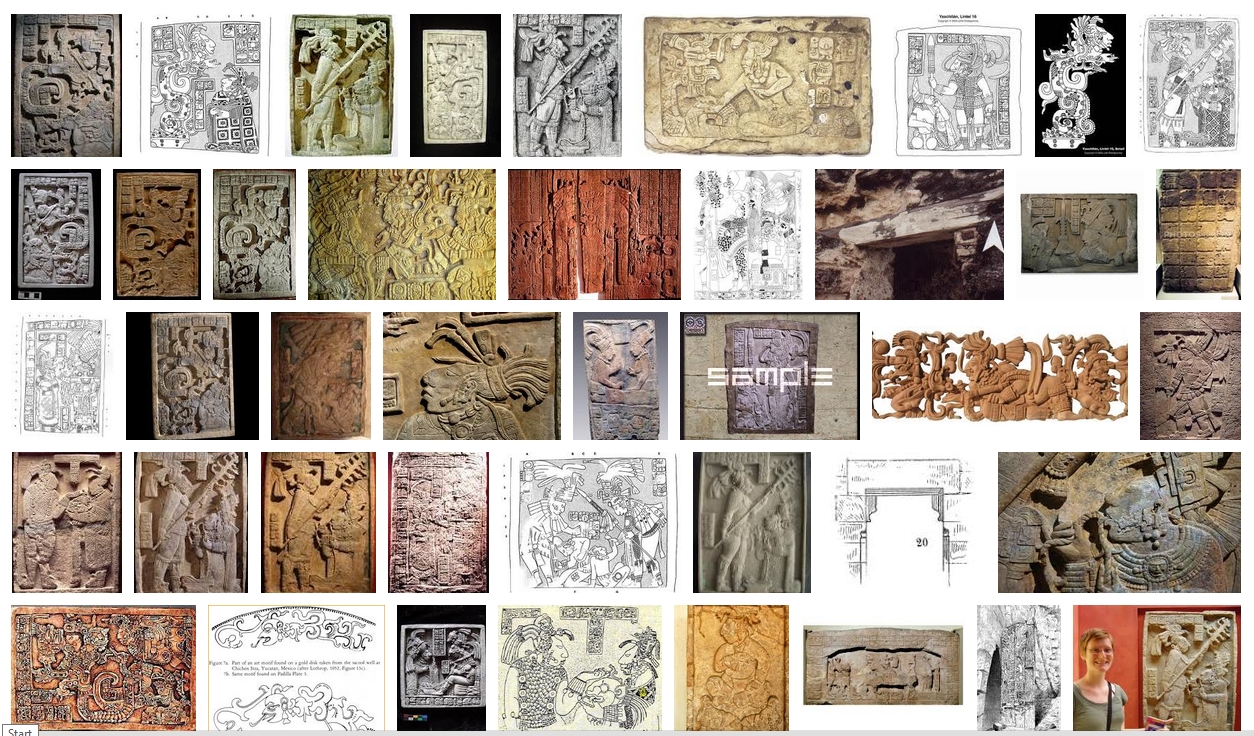
Example Lintel
Example jade artifacts and burial goods
Example Stela
3D Map of Tikal (Tikal = Hawawa Complex of my 4e game)

Google Image Search:  Mayan Lintel
Google Image Search: Mayan Burial Mask
Google Image Search: Mayan Stellae

Related Posts Plugin for WordPress, Blogger...