Thursday, January 24, 2013

Huwawa Complex

The players in my 4e game are mucking around in a loose analog of Tikal (see this text and image dump post for some Tikal flavor) I am referring to as the Huwawa complex after the imprisoned godlike force that is bound below the lowest dungeon level.

 I used the central structures of Tikal for the surface layer, with a 3 level dungeon underneath.  I sketched the dungeon maps free hand in isomorphic view.  I added the graph lines by hand.  I was a little drunk when I laid down the original perspective lines and in many cases they vary wildly from true.

I scanned in the maps and messed around with them for a minute in Photoshop.  This first one is color coded by level depth: Blue = Level 1; Green= Level 2; Red=Level 3; and Yellow=Level 4 (the very surface layer of the imprisoned entity below the dungeon levels).

Now here is a map color coded by connections to the surface structures: Red = vertical connections with the Central Acropolis; Green = vertical connections with Temple II; Purple = vertical connections with the North Acropolis; Yellow = vertical connections with Temple I and Blue = vertical connections with the structures to the east of Temple I, which in my analog is another temple pyramid similar to Temple I and II.

The awesome thing is the party actually has architectural plans of the complex from the library they looted a few sessions back, so this post isn't even technically a spoiler!  Of course, the party managed to figure out a way to use the solid jade portals that only allow the dead to pass through them, so they have been teleporting all over the dungeon using the lich doors and they probably won't even end up seeing most of the place before they get the loot they came for or die trying.

Tuesday, January 8, 2013

Level 9 Guitar Player


Alexis posted in his usual well spoken but curmudgeonly way about XP buy systems of leveling up, or "arcade games" as he calls them.  I love Alexis for not being afraid to just let it rip and write his mind.  Half the time I think he is an old man shouting at kids in his lawn about their arcade games and half the time I think he is a total genius.  Being a genius half the time is good enough to keep me coming back to his blog, at any rate.

I started to write a comment in response to this sentence of the post:  "I'm curious as to how this works out logically, however.  Not that I feel the game has to be 'logical,' but since experience points represent, well, experience, how exactly does one become LESS experienced in the process of gaining a better strength or a nice new gnoll knee knocker?"

My comment grew some roots and sprouted into this post:

On the odd chance this was not a rhetorical question, spending experience points to gain some specific skill at the cost of not advancing another skill as fast or even deteriorating another skill, makes perfect sense to me.  The basic situation as I understand it that you are presenting is a PC spending XP on some bonus ability rather than on leveling up (leveling up being defined as a different set of ability increases).

I have played guitar for going on 17 years now, and in general you could view my playing career as a steady increase in experience and ability, with new levels of expertise achieved over time.  Your traditional D&D model.

Now since this is real life of course I do other things besides just play guitar.  For the last year I have spent comparatively less time playing the guitar, I have not been performing live, I have not been recording, and I have spent much more time at a new job (a salaried position, which has turned out to be a terrible idea in terms of the amount of time I put in).

In game terms, I spent my XP points from this last year of living on a bonus profession to earn me more money rather than continuing the obvious point of the game, to perfect my guitar mastery :)

Perhaps I might have achieved name level this year in guitar if I had not spent my XP on this arcade game of a job!

What has happened to my guitar skills in the meantime?  Can I and do I pick up my guitar regularly and make beautiful, high level music?  Sure!

Is my playing ability at the same level it was when I was devoting much more time to it?

Of course not!

Have I in fact slipped slightly in some measurable levels of player ability due to spending more of my experience points picking up a whole host of new skills related to my new job?

Yes.  Sometimes the run that I hear in my head stutters on the way to the fingers and I end up having to slide a half step to cover a missed note.  My hands are physically weaker to the point that when I get on my friend's bass guitar and jam for an hour my hand feels like it is going to cramp up and my fingers burn.  My calluses are gone.  I am not placing the meat of my fingerpads precisely at the point where the note will sound true and not buzz or vibrate.  The unique vibrato muscles in my left pinkie finger seemed to have almost completely deserted me.

I feel that XP purchase systems are almost always more "realistic" than the standard D&D level up method. That is not to say they are actually realistic, but if they take into account that the average person is simultaneously bettering many skills and letting many skills slip out of practice, they have a massive leg up on D&D with its strange idea about classes.  You could hardly come up with a more unrealistic way to model humans gaining experience than the D&D class based leveling up system.

Monday, January 7, 2013

Prep for next session

 Wiki Maya Death Rituals:

"The Maya dead were laid to rest with maize placed in their mouth. Maize, highly important in Maya culture, is a symbol of rebirth and also was food for the dead for the journey to the otherworld. Similarly, a jade or stone bead placed in the mouth served as currency for this journey. Often, whistles carved from rocks into the shapes of gods or animals were included in the grave offerings to help the deceased find their way to the spirit world. The Maya associated the color red with death and rebirth and often covered graves and skeletalremains with cinnabar. The bodies of the dead were wrapped in cotton mantles before being buried. Burial sites were oriented to provide access to the otherworld. Graves faced north or west, in the directions of the Maya heavens, and others were located in caves, entrances to the underworld.
Burial practices of the Maya changed over the course of time. In the late Preclassic period, people were buried in a flexed position, later the dead were laid to rest in an extended position. In the late Classic period, the elite constructed vaulted tombs, and some rulers ordered the construction of large burial complexes. In the Postclassic periodcremation became more common.

[edit]Tombs

There have been many archaeological discoveries of lavish tombs within ceremonial complexes from the Classic period. However, only a Maya city’s most important ruler was buried in this way. These aristocrats were placed in tombs at the bottoms of funerary pyramids that sometimes consisted of nine stepped platforms, perhaps symbolizing the nine layers of the underworld. Other temples were constructed with 13 vaults the symbolizing the layers of the heavens in Maya cosmology. These temples reflected the continued worship of these nobles. In some instances, members of the royal family or young attendants would be sacrificed to accompany the lord in death.
The tombs were filled with precious goods including fine polychrome pottery, effigy figurines, jade and marble pieces, masks, mushroom figures. While these figures were found in Maya tombs, many of these items were also used in the service of food, drink and for additional ritual purposes.[1] Obsidian and exotic shells have also been found in Mayan tombs.
Other elite members of society were buried in vaults. The bodies of higher-ranking members of society were buried inside sarcophagi. They sometimes were buried in crypts or underneath the family home. These funerary constructions of the royal often destroyed the residence itself. Commoners were also buried near or under their houses. These graves did not have extensive burial offerings, but often contained objects that identified the individual: a tool or possession."
Example ceramic artifact from the complex
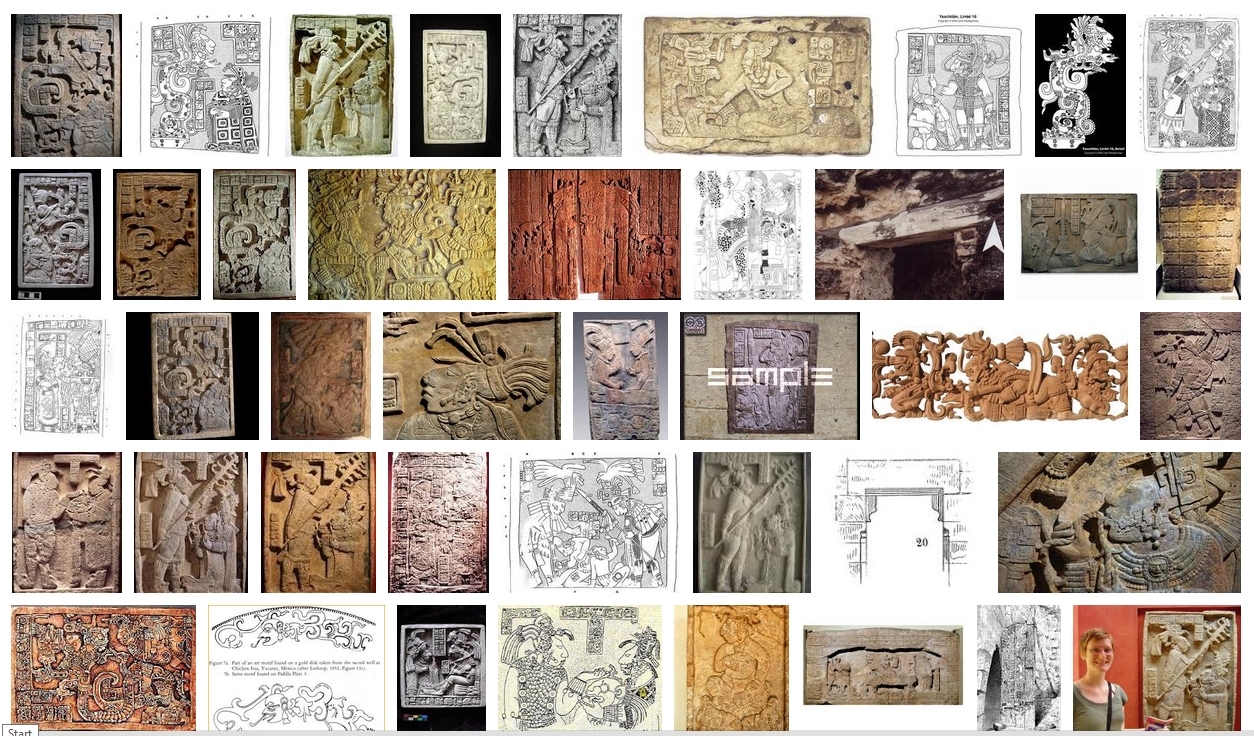
Example Lintel
Example jade artifacts and burial goods
Example Stela
3D Map of Tikal (Tikal = Hawawa Complex of my 4e game)

Google Image Search:  Mayan Lintel
Google Image Search: Mayan Burial Mask
Google Image Search: Mayan Stellae

Saturday, December 29, 2012

Christmas Loot DM's Notebook

My wife listened to me well and got me an awesome present this Christmas.  She bought me two really nice large blank unlined hardcover notebooks with sturdy bindings to use for my DM's notes. She got my name inscribed on the front and a dark brick red cover that reminds me of some old textbooks I have.  I usually scribble my notes in random lined notebooks, on graph paper or in art notebooks.  None of those typically hold up well in my backpack as they are used heavily for a year.  My usual DM's notebooks are a tattered wreck by the time I fill them up and move on to the next one.  These feel really solid, the binding looks great and the book opens up rather nicely.

The stats:  168 pages, cover dimensions: 13 3/4" x 9 1/8" x 7/8", inside page dimension:  13 1/2" x 8 7/8"

Here is the new book open to my first page of notes, with my other active notebook of standard size paper open on top of it for comparison.

Here is the book closed with the regular notebook closed for comparison.
Here is the binding from the outside.

After I fill up these two she is going to buy me new and different ones, so from here on out I will have an awesome collection of my DMs notes, well bound in sturdy hardcover.

Friday, December 21, 2012

Let it fly for all to see

One of my favorite DMs tricks is to make a quick decision as to the probabilities of some possible outcomes facing the party and then convert that into a dice roll that I do in front of everyone, clearly stating the parameters of the throw before letting it fly.  This is of course an alternative to simply deciding what happens and then narrating the events to the players.  It is part of my collaborative world-building philosophy of DMing.  Vocalizing the possible outcomes and throwing in plain view makes the moment of suspense as the dice roll across the table a shared moment between the players and the DM, instead of that awkward moment behind the screen as the dice are thrown and interpreted in inscrutable mystery.  Plus it eliminates the compulsion to "cheat" and ignore the behind the screens dice throw :)

Often I introduce far worse possible consequences than I would have comfortably decided upon by fiat, cushioned by the unlikelihood of rolling that nat 20 for the outlier result.  I have had d100 rolls to end the universe, and d20 rolls to blow up the entire party to smithereens.  For the random rolls that contain truly horrific outcomes I delight in making a party member do the actual rolling.  So you want to take the time-travelling hummingbird-masked sorcerer up on his dare and jump into the lava tube down to the magma chamber like he did?  You plan to replicate the complex ritual he did with his bad hummingbird self as he fell and jump into an existence outside of time and space like he did?  If you roll a 1 you are going to be dead with no possibility of a raise and all your equipment will be lost.  You still have a chance to chicken out... roll a d20...

During the last session of the 4e game I run I had several out-in-public rolls involving a rift to the future and a robotic incursion into a sacred grove in a volcanic crater.

16 or higher, more of the future robot mining machine comes through the time rift, 15 or lower, it stays put.  

10 or higher, the time rift to the future grows wider, lower than 10 it shrinks.

1-3, the robot dragonfly shoots a missile at Beautiful Bob, 4-6 at Hammer.  (I like d6 throws for determining who in the party gets attacked.  Always have.)

I am sad to say that I used my nightly d30 roll for the first example last session and did not manage a 16 or higher (to my chagrin).


Likewise I failed to roll a 10 or high on a plain ole d20 attempt at the second example.

Next time, my pretties!


Friday, December 14, 2012

One Disappointed Hobbit

I went to my first midnight movie screening last night, The Hobbit: An Unexpected Journey, with my wife, sister-in-law, and sister-in-law's fiancee.  The experience itself was enjoyable and mildly exciting, with a long line stretching out into the parking lot even though we had shown up 30 minutes earlier than our screening time.   We waited out in the cold with all the other excited midnight moviegoers.   The staff of the movie theater was abuzz, all hands on deck, managers walking around in suits coordinating the lines, the popcorn machines hardly pumping out enough to satiate the hungry mob.
"Good Looking Dwarf" Numero Uno

And then the movie happened.  I didn't have high expectations after learning the story of the Hobbit had been split into three movies, but I was still very disappointed.  I think my malcontent started the second the first of the "good looking" dwarves showed up, peaked with Radagast the Brown's entire run in the movie and then just sort of ended with a whimper when I could have given a shit if every one of the dwarves somehow managed to jump from tree to falling tree and finally skydive to the safety of the soaring eagles below or not.

There were highlights for sure, the beautiful landscape of the middle earth being chief among them for me.  Gollum was beautiful to look at and matched my childhood imaginings eerily well.  But the story they chose to tell here really was not the Hobbit that I remember.

I guess I will have to watch it again when it does not end at 3 AM and give it a fair shake.

Thursday, December 6, 2012

How I DM in 30 Words

Throw a lot of hooks out there.  Whichever ones get sniffed by the PCs, throw a few more hooks out related to those ones.  Write 'em down.  Rinse and repeat.

The key is to really make sure it is a LOT of hooks that you throw out initially, and then like a hydra you throw out five new ones whenever one old one is chased down.  The rest is all details.  When the PCs decide to attack something related to one of the hooks, then combat happens.  When the PCs decide to investigate a hook, you get to improvise some more hooks based on that one.  Write them down.  Don't worry about trying to make them awesome, or trying to make them make sense.  The PCs will figure out inter-connections that you could never have dreamed of.  And you know what?  The improvised hooks you throw out there all come from your imagination... they have a shared heritage... chances are they are inter-connected in ways that you are not fully aware of consciously.  They are informed by your own unique DMing lifeblood and should be trusted.

Outside of sessions, D&D is a fun strategic wargame of the mind as you spin out possible scenarios for what is happening outside of the PC's control in the world.  You should have a lot of hooks dangling out there, and many of them will be swinging out of sight and mind of the party.  But as long you let the PCs keep chasing after hooks of their own volition, you have to respect where that chase may take them, and trust in your ability to improvise some fun details.

My 4e game started in a new-world setting, with the Forgotten Realms being the colonizing power to the west.  The east shore of the new world was a narrow rainless desert overshadowed by an impenetrably steep and high mountain range that ran north-south down the entire continent and had thwarted all past attempts at crossing.  A fertile river valley had recently been discovered on the desert coast and the first expeditions found gold in the streams in great quantities.  The PCs arrived on a ship mostly full of slaves destined for the mines and found a port settlement decimated with a plague the settlers called the "white death".  I threw out a bunch of hooks and the PCs have been merrily wreaking havoc ever since.

Rinse and Repeat for three years, and the party has spent as much time in alternate dimensions, on alien planets, creating alternate timelines, and utilizing altered states of awareness as they have spent in the jungle, and they have loved every minute of it. I have had my work cut out for me keeping up with the directions they chase my leads off in, and I continually surprise myself with how well it all works out and connects with itself when I look back at the whole that has been constructed between the players and myself during this game.

Tuesday, November 27, 2012

Pterosaurs

I have always been fascinated by pterosaurs.  I loved all manner of dino-critters when I was a wee lad, memorizing the names of several bookfulls before I was in kindergarten.  It's probably no surprise that I like to stick dinosaurs into the RPGs that I preside over even if genre and convention would dictate otherwise.  As soon as the PCs in my 4e game crossed the great mountain range and descended into the seemingly endless jungle beyond, they ran into a group of allosaurus.  When they first encountered the volcanic island  at the confluence of the of the major tributary rivers of the Zamonas, they saw winged dinosaurs soaring on the thermals overhead (yes, I know that pterosaurs are not actually dinosaurs, but come on).

I get to geek out on dinosaurs this week in my prep work for my 4e game, because the players time jumped into the past at the end of last session.  As far as I am concerned, if your PCs time travel into the past, there better be some dinosaurs on the other side.  Conveniently I just bought myself a cool book on dinosaurs which I am going to spend the evening looking through, but first I did some internet searches on pterosaurs.

Often Google image searches of real life monsters like pterosaurs or deep sea critters yield some incredible results.  Feast your eyes on this awesomeness (image lifted from this website about pterosaur flight).  It is a dimorphodon.

I ended up sketching the dimorphodon picture in my game notes, along with a Quetzalcoatlus (the largest pterosaur ever discovered, with a wingspan that may have stretched greater than 30').  Then my wife got home from work and colored my pen and ink sketches, so I figured I should upload the end result.

Quetzalcoatlus 

Fire Breathing Pterosaur


I added a bit of a Pelican like pouch to the beak, because this is the ancestor of the dragons of my world.  A colony of chemosynthetic, heat-resistant bacteria live in and coat the inside of the beak, digesting minerals that the Quetzalcoatlus scoops into the beak-pouch and emitting a flammable gas as a by-product which is stored in special sacks along the neck.  The heat-resistant bacteria also coat the gizzard, and the fire-breathing pterosaur swallows live embers and keeps them in the gizzard until blowing them out mixed with the gas to form a fiery blast. 

Dimorphodon

Killer Toothed Pterosaur


My wife thinks her version is colored "much more realistically" than the original artist's.  She does have a lot of experience handling raptors so maybe I will believe her. 

Monday, November 19, 2012

The Library of the Bati-Bati Temple

The players in my 4e game recently looted a temple's library.  Most of the literature was inscribed on clay tablets and stacked on massive stone shelves, with a few smaller wood shelves of papyrus and vellum scrolls in bone tubes.  The party webbed all the contents of the shelves securely and then put shelves and all in pocket dimensions that they created for that purpose.  Showing uncommon foresight, they recorded the relative positioning of the shelves before they stowed them in hyperspace.  They literally looted the library, which made my mental jaw drop and led to some very fun DM's prepwork as I told them I would have to get back to them on the exact contents of the library.

Before the party jumped into the future to fight a vampire, they left an NPC (Wa' Halia, an escaped slave from the Temple of the Bull in Siss-Anor who had been trained as a scribe and librarian for the temple library, picked up by the party a few sessions earlier) with the task of cataloging the contents of the library.  Luckily, Wa' Halia was a ritual caster who actually had both the ability to read the various languages of the collection and experience as a librarian, so she is going to have a detailed report for the party... which I told the players I would just post on my blog for them between sessions. 

This is the third library I have tossed hints of to the party, but the first that they had physically encountered (let alone looted).  They had previously heard about the sunken temple city of Adamaskas with its great library maintained by monks preserving the early records of the seven city states and the library of the Temple of the Bull in Siss-Anor (the temple they heard about a long time ago but it was not until a few sessions ago when I introduced Wa'Halia that they learned about the library at the temple, the second largest library of the coastal city-states).

The Library of the Bati-Bati Temple

Wa'Halia's report:  

Not entirely what I would expect from a library from the late temple era (12,000-10,000 YA), the bulk of the collection is written in an ancestral form of the modern tongue and inscribed in clay in the temple style of the old river god civilizations.  One peculiarity of the temple collection is that nearly all the tablets are circular.  Some of the subject matter is unusual in general but perfectly in keeping with the dedication of the temple to the Bati-Bati and the worship of the dark gods of death and transformation.  The collections of astronomy might even exceed those held in Adamaskas, long believed by most knowledgeable sages to be the greatest collection of celestial knowledge ever assembled.  Very unusual for a late temple era library are what appear to be archaeological collections of the earliest languages preserved in clay in the region (~40,000-35,000 YA), even including tablets dedicated to gods ideologically opposed to the death and transformation gods.  One set of tablets appear to be alien in origin, the composition of the materials is unknown to me and the engravings change as the tablets are rearranged.

Works Concerning the Gods of Death and Transformation:  Huana-Hatle, god of were animals and death; Supay, ruler of the underworld and horned demons; and Ilamatecuhtli, aged goddess of earth, death and the galaxy whose roar signaled war.  Each god is represented in the collection by several different epic histories, some of which appear to have been collected from earlier inhabitants of the region judging by language differences and inscribing style; prayers and hymns;  and detailed instructions concerning every aspect of all associated ceremonies and sacrifices.

History of the Bati-Bati:  Known incursions of the Bati-Bati into this reality; a record of every lunar eclipse related to Bati-Bati activity; descriptions of the mind-warping abilities of the Bati-Bati; various legends linking the Bati-Bati to the gods of death and transformation; symbology of the Bati-Bati; descriptions of several journeys into Bati-Bati reality by the priesthood over the years; detailed anatomical notes of the physiology of the Bati-Bati.

Histories of the Priesthood and Temple: (1/4 of the collection by volume) Dates of birth and death of the priests; calendar roll of all ceremonies and sacrifices, major and minor, through the years; individual biography tablets detailing major life events of important priests, updated throughout their lifetime; ranks of the undead priests (dating the beginning of the undead priesthood tradition at this temple to 11,130 YA); and genealogies of the troll breeding programs (which interestingly begin in the earliest days of the temple and continued uninterrupted until the collapse of the island civilization).  Notable individual biography tablets include: Epunamun, great statesman and warrior who entered the church after a career in the army commanded by the kings of the island; Anhanga, who came to fame as a necromancer and instituted the tradition of the head priest joining his predecessors upon death in an undead council that shared power with the living head priest; Maricanchi, who rose from obscurity with a series of prophetic dream revelations and ended up being sponsored first by Epunamun and later by Anhanga while creating the star chamber, dream tablet and the dimension shifting properties of the temple from instructions he received while dreaming; Trumak the Keeper of the Chamber, an outsider to the temple who succeeded Maricanchi as master of the star chamber and dream tablet and created the ritual separation of all star chamber operations from the temple proper; and Mamagal, an otherwise seemingly minor figure from the early priesthood whose prophesies were uncommonly accurate, who I had previously identified as being the same author as Maricanchi because of a very unusual and characteristic way of inscribing date characters that marked the prophesies of both men (this stood out enough to me while I was looking through the collection of prophesies that I am now puzzled to note that Mamagal and Maricanchi apparently lived nearly 800 years apart but wrote in an identical style).

Astrological and Astronomical Collections: (1/2 of the collection by volume) Celestial observations and predictions of the early priesthood from 12,000-11,130 YA, reflecting a two dimensional understanding of constellations as seen from a surface perspective but a very accurate understanding of the motions of the planets, eclipses, comets and meteor showers; and the staggering output of the newly founded college of astronomy after the introduction of the shadow table and the star chamber paved the way for a three dimensional understanding of every star's relative position to each other and the world (11,130 YA - 10,000 YA).

Epunamun's Edicts:  A series of broad sweeping reforms authored by Epunamun, these edicts centralized power within the church into the hands of a head priest, set limits on the powers of the council of elders, specified allowable uses of tithe received by the temple and mandated certain portions be set aside for a variety of purposes; mandated early childhood education within the priesthood, established several colleges, raised an army, established protocols for training officers, and authorized the church to aggressively convert neighboring tribes into tribute paying worshipers of the temple.

Anhanga's Necromantic and Animating Collections:  Copies pressed from originals in the Adamaskas collection, easily identifiable by the characteristic angular Adamaskan characters, reproducing the necromantic and animating knowledge of the early (25,000 - 20,000 YA) and middle temple period (20,000 - 12,000 YA, prior to the last meander of the Zamonas river); papyrus copies of several notable dissertations submitted by sorcerers to the council of the lich kings including Manu Jablitu's famous treatise arguing that certain metals found on alien planets in alternate realities could enable animation of far larger structures with far less expenditure of power than held possible by the lich kings (these dissertations and many others are often referenced in texts held at the Temple of the Bull but all known copies outside of Adamaskas were destroyed 10,000 YA after the collapse of the old temple system); three studies commissioned by Anhanga on the monumental architecture of the middle temple period, focusing on the temple complex surrounding Kariki-Kalos and two other temple complexes built around imprisoned godbeasts in the jungle; and a collection of advanced necromantic rites authored by Anhanga himself.

Prophesies:  A collection of predictions and dates, on subjects ranging from rainfall and propitious times to conceive a child to the ultimate collapse of the universe.  The priests did not foresee the calamitous downfall of the island civilization.  Early prophesies are inscribed on two sides of a tablet, with two possible date readings.  Prophesies made with the aid of the star chamber (11,130 YA - 10,000 YA) have only one possible date reading.

Nightmares:  A collection of recurring nightmares endured by leading undead priests.

Alchemical Collection:  Recipes for potions and poisons; instructions for the transmutation of metals and the creation of alloys, reflecting what appears to be a more advanced understanding of metallurgy than presently found in the empire.  This collection is etched on gold plated copper tablets.

Anatomical and Herbal Notes and Drawings:  A rather extensive illustrated herbal of jungle plants and anatomical drawings of humans and animals.  The organs and vital points are given names that clearly place the origin of these works with the Gadoro Temple.  These are the only vellum scrolls in the collection and great care was taken in their creation.  Epunamun's seal was unbroken on the ivory tubes.

Archaeological Collections:  A collection of what appear to be artifacts from the ancestral populations of the jungle lowlands, including: Clay tablets; ceramic pottery; wood, stone and bone tools and weapons; beads of many materials; masks; feathered headresses; feathered capes; and penis gourds.


Gaming Artifact for submission to the D&D Library of the Future:
My original page of notes about this library (this page also contains some gameplay notes in the right margin from the session the players looted the library) 


Tuesday, October 16, 2012

Guachimines "Guacamole" Left Hand of the Keeper and the Jump to the Future

The players in my 4e game surprised me last session by deciding to track a fleeing vampire into the jungle rather than deal with any number of what I had figured would be seen as more pressing matters.  They had ended the previous session at one of those crossroads moments when they had just wrapped up one little mission and had a wide open decision about what to do next.  I try not to over prepare as a DM in these situations because you never know what the party is going to do, but I figured they were most likely to either cash in on the offer to be introduced to Ruskus and his band of River Dragons that was made by the defeated slaver a few sessions ago (and learn more about another aspect of the fractured river deity), visit their connections in the city of Siss-Anor (to learn more about the activities of the snake men) or investigate the ruined dungeons left behind when Manu Jibleetu blasted off into space in his twisted tower.

So of course they decide to chase after a vampire that they didn't even know about until two sessions ago and who has really never done anything to the party, or even done anything to make himself a logical target.  He just existed, and he was a vampire, and he ran away, and apparently that was enough to make the party chase him.  His name is Guachimines and his title is Left Hand of the Keeper, but the party has been calling him "Guacamole" and I even found myself calling him Guacamole a few times last session when I wasn't being careful.  Guachimines was created by Trumak, the Keeper of the Chamber, who was defeated by the party two sessions ago and his consciousness trapped in a blood gem.

The party knew Guachimines was originally from the head-hunting tribes that lived in the foothills of one of the Zamonas' major tributary rivers, and figured he might be heading back to his old homeland.  At first they were just going to fly the hovercraft over to the hills and find his home village and poke around there before he showed up, but eventually they figured out that they could track him directly through his connection to his master Trumak, even though Trumak was mostly destroyed and what remained was bound inside the gem.

The party eventually caught up to Guachimines and his group (Guachimines had several vampire thralls and 18 abducted river worshipers with him that he had transformed into a flock of bats and flown off with) about 50 miles from the confluence and discovered that they had arrived about a half hour too late to keep Guachimines from jumping into the future.  An uneasy standoff with the vampire thralls ended surprisingly with a decision to parlay with Ibi Shadowhands, the leader of the thralls.  Most of the vampire thralls had one arm that ended in a large metal flamethrower, but both of Ibi's arms ended in shadow appendages intended to make him a more formidable ritual caster.  When Guachimines jumped into the future the vampire thralls suddenly found themselves free willed and masterless for the first time.  Ibi turned out to be a somewhat sympathetic character and the party, after much debating, decided to spare the lives of the thralls and task them with rebuilding the Badi-Badi temple that the party had just destroyed, minus the complex shadow circuitry.  This pleased the thralls, who had been members of the temple in life and then had spent thousands of years of undeath assisting in the rites of the chamber.  I think this also helped appease Tilia a little bit about the decision to spare their lives, because Tilia had been upset that the rest of the party destroyed the temple while she was lucid dreaming on the shadow table trying to figure out more about the temple's past and purposes.

After investigating the bloody ritual sacrifice of the 18 worshipers and the intricate pattern of entrails left behind by the time jumping vampire, Beautiful Bob called on the restless spirits of the recently slaughtered to help the party follow the vampire into the future.  He succeeded wildly and the session ended a little early with me saying that I wanted to make sure I was fully prepared for the awesome encounter that was sure to follow.

You see, even though the party was almost an hour behind Guachimines when they too jumped into the future, they are going to arrive at the exact same instant of time as Guachimines does... and he will have no idea they are coming.  Guachimines will have the advantage of terrain, having jumped into his secret future lair, but the party will have the element of surprise.

This is going to be fun.

There was some amusing back and forth before the jump as the party instructed Curious George (their sentient magical hovercraft) to "meet them in the future" but not tell them about anything their past selves said after they came back from the future.  That way, they told me, Curious George wouldn't influence the events in the future present and they could come back to the proper past.

Ah, I love time travel.


Related Posts Plugin for WordPress, Blogger...